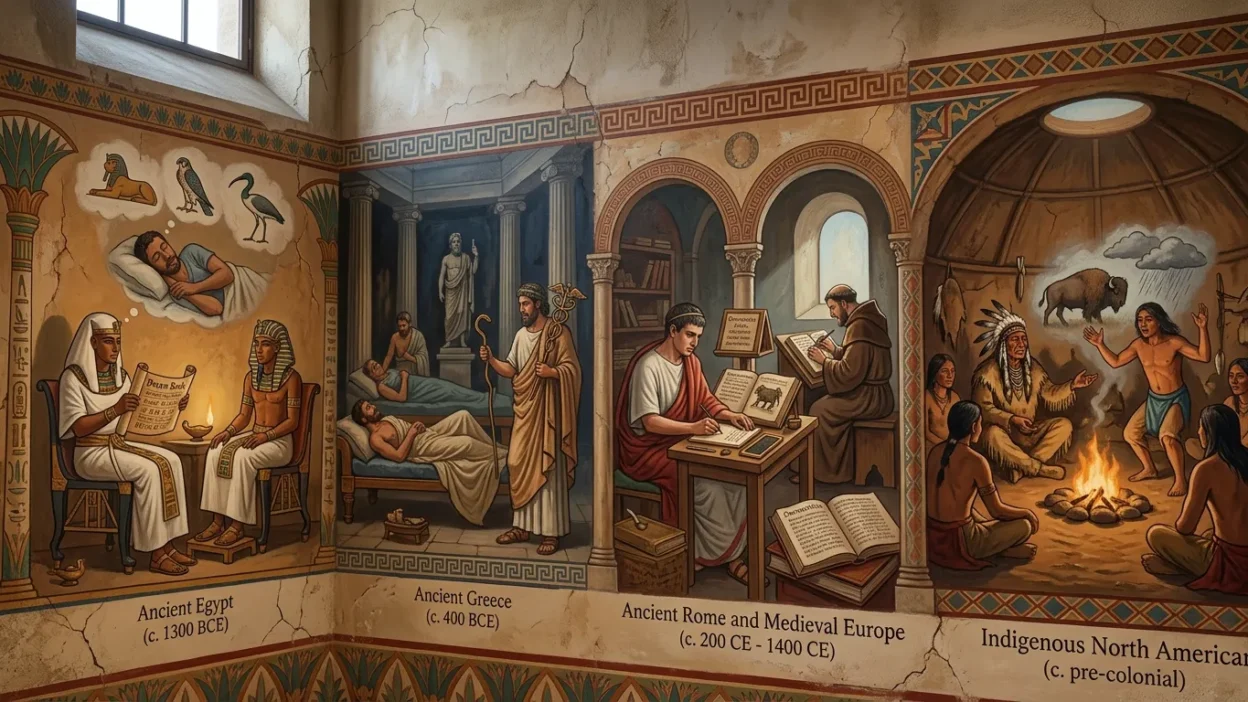
Dreams have fascinated humanity for thousands of years. Across civilizations, people have viewed dreams as messages from the divine, reflections of the subconscious mind, warnings of future events, or simply the brain’s way of processing daily experiences. The meaning of dreams has evolved significantly throughout history, influenced by religion, philosophy, psychology, and scientific discovery.
Today, there is no single explanation for why we dream or what every dream means. Instead, modern understanding combines insights from history, spirituality, psychology, and neuroscience. By exploring historical perspectives on dream interpretation, we gain a deeper appreciation of how different cultures and thinkers have understood the mysterious world of dreams.
This guide traces the history of dream interpretation from ancient civilizations to contemporary psychological and scientific approaches.
Why Have People Always Been Interested in Dreams?
Dreams often feel vivid, emotional, and meaningful. Throughout history, people have asked questions such as:
- Why do we dream?
- Are dreams messages from God or the gods?
- Can dreams predict the future?
- Do dreams reveal hidden truths?
- What can dreams teach us about ourselves?
Different societies answered these questions in different ways, shaped by their beliefs and knowledge.
Dream Interpretation in Ancient Civilizations
Ancient Egypt
The ancient Egyptians considered many dreams to be messages from the gods.
Priests often helped interpret dreams, believing they could provide guidance about:
- Health
- Government
- Personal decisions
- Religious matters
Dreams were so important that some people practiced dream incubation, sleeping in sacred temples in hopes of receiving divine guidance through dreams.
Ancient Mesopotamia
In ancient Mesopotamia, dreams were frequently viewed as communications from divine beings.
Kings and rulers sometimes sought dream interpretations before making major decisions involving:
- War
- Politics
- Leadership
- Religious ceremonies
Dreams were carefully recorded and compared with traditional interpretations.
Ancient Greece
The ancient Greeks held diverse views about dreams.
Some believed dreams came from the gods, while others saw them as natural mental experiences.
The physician Hippocrates suggested that dreams could reflect a person’s physical health, making dreams relevant to early medical practice.
People also visited healing temples dedicated to Asclepius, where they hoped to receive healing dreams that would guide their treatment.
Ancient Rome
The Romans inherited many Greek ideas about dreams.
Some emperors consulted dream interpreters before making important political or military decisions.
At the same time, Roman philosophers often debated whether dreams truly predicted future events or simply reflected ordinary thoughts.
Dream Interpretation in the Bible
The Bible contains several well-known accounts of meaningful dreams and their interpretations.
Among the most famous examples are:
- Joseph interpreting Pharaoh’s dreams about years of abundance and famine.
- Daniel interpreting dreams and visions for Babylonian kings.
- Joseph receiving guidance through dreams concerning the safety of his family.
These dreams served specific purposes within the biblical narrative. However, the Bible does not teach that every dream carries a divine message or that every person should expect dreams to predict future events.
A biblical perspective encourages discernment, wisdom, and evaluating experiences in light of God’s revealed truth.
Dream Interpretation During the Middle Ages
Throughout the Middle Ages, many people continued to believe dreams could have spiritual significance.
Religious scholars often distinguished between dreams that might:
- Encourage moral reflection
- Reflect ordinary daily concerns
- Be influenced by imagination or physical conditions
Interpretations varied across regions and religious traditions, with caution encouraged when assigning supernatural meaning to dreams.
The Renaissance and Enlightenment
During the Renaissance, growing interest in science and philosophy led many thinkers to study dreams more critically.
Rather than viewing every dream as supernatural, scholars increasingly considered:
- Human imagination
- Memory
- Emotions
- Natural explanations
The Enlightenment emphasized reason and observation, reducing reliance on mystical explanations for many dream experiences.
The Birth of Modern Psychology
The late 19th and early 20th centuries transformed dream interpretation.
Sigmund Freud
Sigmund Freud published The Interpretation of Dreams in 1900, arguing that dreams reveal unconscious wishes and unresolved conflicts.
Freud distinguished between:
Manifest Content
The dream as remembered.
Latent Content
The hidden psychological meaning beneath the dream.
Although highly influential, many aspects of Freud’s theory remain debated today.
Carl Jung
Carl Jung expanded dream theory by emphasizing:
- Personal growth
- Universal archetypes
- The unconscious mind
- Psychological balance
Jung believed dreams help individuals understand themselves more fully rather than simply disguising hidden desires.
His ideas continue to influence dream research and psychotherapy.
Modern Scientific Perspectives
Today’s sleep researchers study dreams using neuroscience rather than symbolic interpretation alone.
Research suggests dreaming may contribute to:
- Memory consolidation
- Emotional processing
- Learning
- Creativity
- Problem-solving
Scientists recognize dreaming as a normal part of sleep, particularly during Rapid Eye Movement (REM) sleep.
However, there is no scientific consensus that ordinary dreams predict future events or possess one universal symbolic meaning.
Cultural Differences in Dream Interpretation
Dream beliefs continue to vary around the world.
Some cultures view dreams as:
- Spiritual guidance
- Communication with ancestors
- Sources of wisdom
- Personal reflection
Others emphasize:
- Psychology
- Brain function
- Emotional health
- Memory processing
Many people combine these perspectives in their own understanding of dreams.
What History Teaches Us About Dreams
Looking across history reveals several important lessons:
- Dreams have always fascinated humanity.
- Different cultures interpret dreams differently.
- Religious, philosophical, and scientific perspectives each contribute valuable insights.
- No single approach explains every dream.
- Personal context remains essential when interpreting dream experiences.
Common Misconceptions About Historical Dream Interpretation
“Ancient people believed every dream was prophetic.”
Not true. Even in ancient cultures, people recognized that some dreams were ordinary while others seemed significant.
“Science has completely explained dreams.”
Not yet. Scientists understand many aspects of sleep and dreaming, but many questions remain unanswered.
“Dream dictionaries provide universal meanings.”
Historical evidence and modern psychology both suggest dream meanings are often shaped by personal experience and cultural context.
Frequently Asked Questions
When did people first begin interpreting dreams?
Dream interpretation dates back thousands of years to ancient civilizations such as Egypt and Mesopotamia, where dreams were often considered messages from divine beings.
Did ancient cultures believe dreams predicted the future?
Some did, particularly in religious or political contexts, but beliefs varied widely, and not every dream was treated as prophetic.
Who is the most famous psychologist associated with dream interpretation?
Sigmund Freud and Carl Jung are the two most influential figures in modern dream psychology.
Does modern science support dream interpretation?
Science supports the study of dreaming as a natural brain process but does not confirm universal symbolic meanings or consistent predictive abilities for ordinary dreams.
Why do different cultures interpret dreams differently?
Dream interpretation is shaped by cultural beliefs, religious traditions, historical experiences, and scientific understanding, leading to a wide variety of perspectives.
Final Thoughts
The history of dream interpretation reflects humanity’s enduring desire to understand the mysteries of the mind and the meaning of our nighttime experiences. From the temples of ancient Egypt to the theories of Freud and Jung, and from biblical accounts to modern neuroscience, each era has contributed valuable insights into the nature of dreams.
While perspectives have changed over time, one principle remains consistent: dreams are deeply personal. Whether viewed as symbols of the unconscious mind, opportunities for spiritual reflection, or natural products of brain activity, dreams invite us to explore our emotions, memories, and personal growth with curiosity and discernment.
Ultimately, understanding the historical perspectives on dream interpretation reminds us that dreams have always inspired wonder—and that the search for their meaning continues to evolve alongside our understanding of the human mind.