Dreams have fascinated people for thousands of years. Some dreams are joyful and inspiring, while others are confusing, emotional, or even frightening. Whether you dream about flying, falling, loved ones, animals, or unfamiliar places, it’s natural to wonder what these experiences might mean. Although some people believe dreams carry spiritual messages and others see them as the brain processing daily life, there is no single method that can accurately explain every dream.
Learning how to interpret dreams involves looking beyond the surface story and considering your emotions, personal experiences, beliefs, and current life circumstances. Rather than searching for one universal meaning, dream interpretation is about discovering what a dream may represent in your own life.
This guide explains practical techniques for interpreting dreams from spiritual, biblical, and psychological perspectives while encouraging a balanced and thoughtful approach.
What Is Dream Interpretation?
Dream interpretation is the process of exploring the possible meaning of a dream by considering its:
- Symbols
- Emotions
- Actions
- People
- Settings
- Personal experiences
- Spiritual beliefs
- Current life circumstances
Because dreams are highly personal, the same symbol may have different meanings for different people.
For example, dreaming about water may represent peace for one person, emotional overwhelm for another, or simply reflect someone who spent the day at the beach.
Why Do Dreams Feel Meaningful?
Dreams often combine:
- Memories
- Emotions
- Imagination
- Hopes
- Fears
- Recent experiences
These elements can create vivid stories that feel deeply personal.
Some dreams may simply reflect everyday concerns, while others may encourage self-reflection or emotional awareness.
Step 1: Record the Dream Immediately
Dream memories fade quickly.
As soon as you wake up, write down:
- What happened
- Who appeared
- Where you were
- Important objects
- Conversations
- Colors
- Emotions
Even small details may become meaningful later.
Keeping a dream journal makes interpretation much easier over time.
Step 2: Identify the Main Symbols
Dreams often communicate through symbols.
Common examples include:
- Water
- Houses
- Roads
- Animals
- Flying
- Falling
- Doors
- Mountains
- Trees
- Clothing
Instead of relying only on general dream dictionaries, ask yourself:
“What does this symbol personally mean to me?”
Your own associations are often the most helpful starting point.
Step 3: Pay Attention to Your Emotions
Your feelings during the dream are often more significant than the events themselves.
Ask yourself:
- Was I happy?
- Afraid?
- Calm?
- Confused?
- Excited?
- Ashamed?
- Peaceful?
These emotions may reflect your waking life more accurately than the dream’s storyline.
Step 4: Connect the Dream to Your Current Life
Ask yourself:
- What challenges am I facing?
- What major changes are happening?
- Have I experienced stress recently?
- What relationships occupy my thoughts?
- What goals am I pursuing?
Dreams often mirror real-life situations in symbolic ways.
Step 5: Look for Repeating Themes
Recurring dreams deserve special attention.
Examples include:
- Being chased
- Falling
- Losing something
- Missing an exam
- Flying
- Returning to childhood homes
Repeated dreams may reflect unresolved emotions or ongoing life challenges.
Step 6: Consider the Entire Dream
Avoid interpreting a single symbol by itself.
Instead, examine:
- The beginning
- The ending
- Your emotions
- Other symbols
- Overall message
The complete story usually provides greater insight than one isolated image.
Common Dream Symbols and Possible Meanings
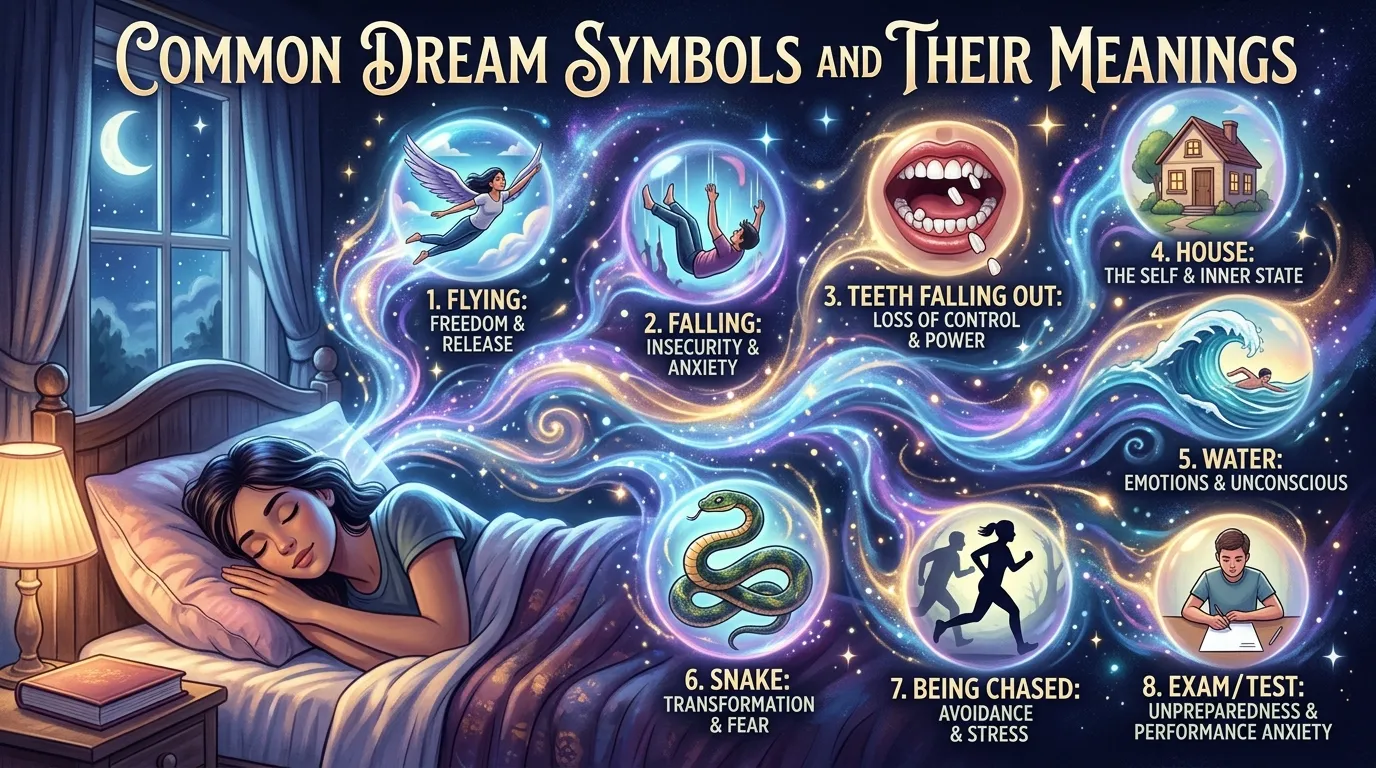
While meanings vary from person to person, some symbols are commonly associated with certain themes:
| Dream Symbol | Possible Meaning |
|---|---|
| Water | Emotions, healing, change |
| Flying | Freedom, confidence, ambition |
| Falling | Insecurity, uncertainty, loss of control |
| House | The self, personal life, identity |
| Road | Life journey, direction |
| Animals | Instincts, emotions, personality traits |
| Light | Hope, wisdom, understanding |
| Darkness | Fear, uncertainty, the unknown |
| Clothing | Identity, reputation, self-image |
| Keys | Opportunity, solutions, knowledge |
These are possibilities rather than fixed interpretations.
Spiritual Perspective on Dream Interpretation
Many spiritual traditions encourage people to reflect on dreams as opportunities for personal growth. At the same time, not every dream is considered a supernatural message.
A balanced spiritual approach includes:
- Reflecting with humility.
- Looking for lessons that promote wisdom and compassion.
- Avoiding fear-based interpretations.
- Recognizing that many dreams simply reflect ordinary experiences.
Dreams can encourage self-reflection without requiring extraordinary explanations.
Biblical Perspective
The Bible records several significant dreams experienced by people such as Joseph, Daniel, and Joseph. However, these were exceptional events rather than everyday occurrences.
A biblical approach encourages believers to:
- Pray for wisdom.
- Compare any perceived message with Scripture.
- Seek discernment rather than certainty.
- Avoid assuming every dream is a direct revelation from God.
Faith should rest on God’s revealed truth, not on dream experiences alone.
Psychological Perspective
Modern psychology views dreams as part of the brain’s natural processing of:
- Memories
- Emotions
- Learning
- Relationships
- Stress
- Problem-solving
Psychologists generally see dreams as meaningful reflections of the mind rather than reliable predictions of future events.
Dream interpretation from this perspective focuses on understanding yourself better rather than forecasting what will happen.
Common Mistakes When Interpreting Dreams
Avoid these common errors:
- Assuming every dream predicts the future.
- Believing every symbol has one universal meaning.
- Ignoring your own emotions.
- Depending entirely on dream dictionaries.
- Interpreting dreams while emotionally distressed.
- Making major life decisions based only on a dream.
Balanced reflection usually leads to healthier insights.
Tips for Better Dream Interpretation
To improve your understanding:
- Keep a dream journal.
- Review recurring dreams.
- Notice emotional patterns.
- Consider current life events.
- Be patient with interpretation.
- Stay open without jumping to conclusions.
Meaning often becomes clearer over time.
Frequently Asked Questions
Can dreams predict the future?
There is no reliable scientific evidence that ordinary dreams consistently predict future events. While some people report dreams that later seem meaningful, most dreams are better understood as reflections of thoughts, emotions, and experiences.
Should I use dream dictionaries?
Dream dictionaries can offer ideas, but they should not be treated as universal answers. Personal experiences and emotions usually provide more meaningful insight.
Why do recurring dreams happen?
Recurring dreams often reflect unresolved emotions, ongoing stress, or life situations that continue to occupy your attention.
What is the most important part of dream interpretation?
Your emotions, personal experiences, and current life circumstances are usually more important than any single dream symbol.
Are nightmares meaningful?
Nightmares can reflect stress, fear, trauma, or emotional concerns. While they may contain meaningful themes, they are not necessarily predictions or supernatural warnings.
Final Thoughts
Learning how to interpret dreams is a journey of self-awareness, reflection, and thoughtful observation. Dreams can reveal emotional patterns, inspire creativity, and encourage personal growth, but they rarely offer simple or universal answers.
Whether you approach dreams from a spiritual, biblical, or psychological perspective, the most valuable interpretation is one that helps you better understand yourself while remaining grounded in wisdom and discernment. Rather than searching for certainty in every symbol, pay attention to recurring themes, your emotions, and how your dreams relate to your daily life.
Ultimately, dream interpretation is less about decoding secret messages and more about asking meaningful questions that help you grow in understanding, emotional health, and personal insight.