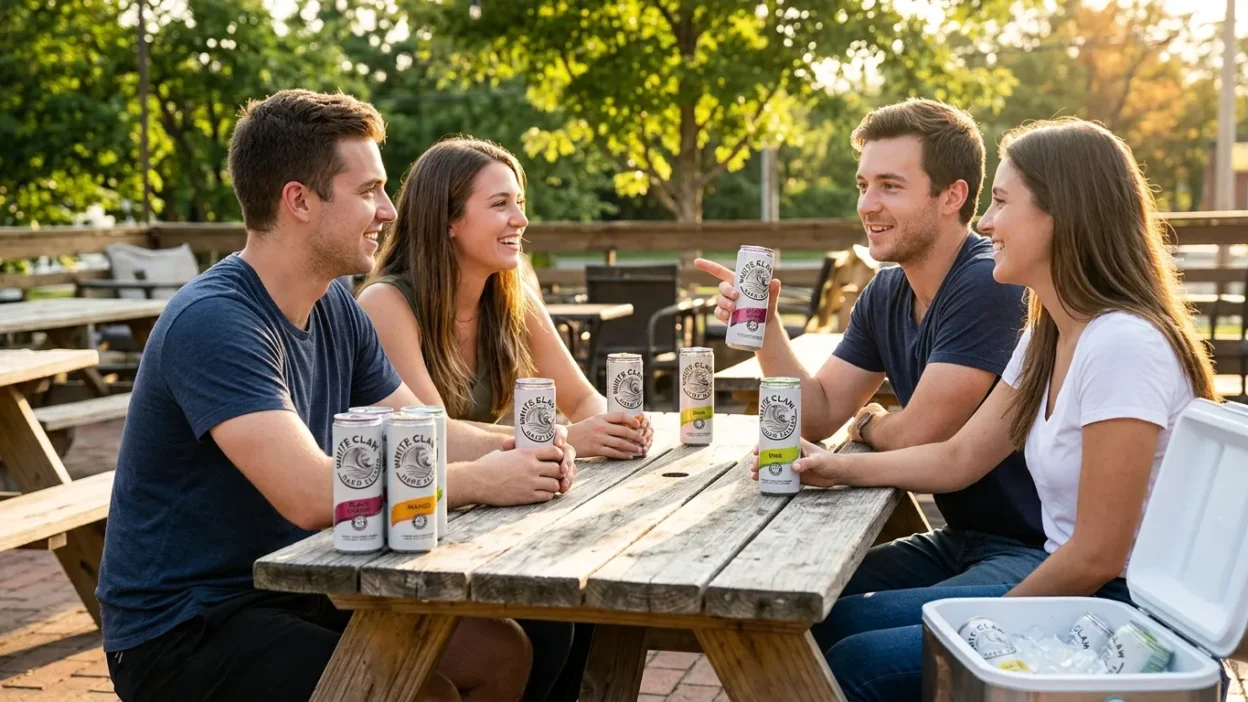
Crack open a can of White Claw and you’ll notice something: it goes down easy. Almost too easy. No heavy hops, no burn, just a crisp, fruity fizz that barely tastes like alcohol at all — which is exactly why so many people underestimate it.
But easy-drinking doesn’t mean low-stakes. White Claw carries the same 5% ABV as most standard beers, meaning it can catch up with you faster than the light, refreshing taste suggests. So how strong is it really, how does it compare to beer or wine, and how can you tell when you’ve had enough?
In this guide, we’ll break down White Claw’s actual alcohol content, how your body processes it, and the science-backed signs that tell you it’s time to slow down — so you can enjoy it without the guesswork (or the regret the next morning).
What’s Actually in a White Claw
White Claw’s standard cans clock in at 5% ABV (alcohol by volume) — the same strength as most mainstream beers like Bud Light or Coors. There’s also a White Claw Surge line at 8% ABV for those wanting something stronger, so it’s worth checking the label rather than assuming every can is equal.
To put that in context using the U.S. standard drink measure (14 grams of pure alcohol):
- One 12 oz White Claw (5% ABV) ≈ 1 standard drink
- One 12 oz beer (5% ABV) ≈ 1 standard drink
- One 5 oz glass of wine (12% ABV) ≈ 1 standard drink
- One 1.5 oz shot of liquor (40% ABV) ≈ 1 standard drink
So a White Claw is roughly equivalent to a beer — not weaker, as the light taste might suggest. The catch is that hard seltzer’s smooth, low-bitterness flavor makes it easy to drink faster than beer, which can lead people to consume more standard drinks in less time without noticing.
How Alcohol Affects Your Body
Alcohol doesn’t hit everyone the same way, even at the same number of drinks. Several factors determine how quickly it enters your bloodstream and how strongly you feel it:
- Body weight and composition — Alcohol distributes through body water, so someone with less body mass typically reaches a higher blood alcohol concentration (BAC) from the same amount of alcohol than someone larger.
- Food in your stomach — Drinking on an empty stomach speeds up alcohol absorption significantly. Eating beforehand, especially protein and fat, slows it down.
- Sex-based differences — On average, women tend to have less body water and different levels of the enzyme that breaks down alcohol in the stomach, which can lead to higher BAC from the same intake compared to men.
- Metabolism and genetics — The liver processes alcohol at a relatively fixed rate (roughly one standard drink per hour for most people), but genetic variation affects how efficiently that happens.
- Tolerance — Regular drinkers may feel less impaired at a given BAC, but their actual coordination, reaction time, and judgment are still measurably affected — tolerance changes the sensation, not the physiological impairment.
- Carbonation — Some research suggests carbonated alcoholic drinks (like hard seltzer) may be absorbed slightly faster than still drinks, which could partly explain why White Claw feels “easy” to drink.
The bottom line: there’s no universal number of White Claws that affects everyone equally. It depends on the person, not just the can.
Understanding BAC (Blood Alcohol Content)
Blood alcohol content (BAC) is the percentage of alcohol in your bloodstream, and it’s the standard measure used to define legal and physical impairment.
Legal limits:
- In most U.S. states, the legal limit for driving is 0.08% BAC.
- Commercial drivers face a stricter limit of 0.04%.
- Drivers under 21 are typically held to 0.00–0.02% under zero-tolerance laws.
Roughly how BAC feels (general reference, not a target):
- 0.02–0.03% — Slight relaxation, mild mood change
- 0.05–0.06% — Lowered inhibitions, minor impairment in judgment and coordination
- 0.08% — Legally impaired; noticeable effects on balance, speech, and reaction time
- 0.10%+ — Significant impairment; slurred speech, poor coordination
- 0.15%+ — Major impairment; risk of nausea, blackout, loss of balance
Why it’s not just about counting cans: BAC is calculated from a combination of the amount of alcohol consumed, body weight, sex, and time elapsed — not simply the number of drinks. Two people who drink the same number of White Claws over the same time period can land at noticeably different BAC levels. This is also why BAC calculators (widely available online and in apps) are more useful than any fixed “X drinks = drunk” rule, since they account for individual factors.
A note on time: The liver can only process about one standard drink per hour. Drinking faster than that means alcohol builds up in your bloodstream rather than being metabolized in real time — which is often the biggest factor in how “hit” someone feels.
Signs You (or Someone Else) Have Had Too Much
Knowing the signs of impairment matters more than counting cans, since — as covered above — the same number of drinks affects people differently. Here’s what to watch for, roughly in order of severity:
Early signs (mild impairment):
- Feeling more talkative or relaxed than usual
- Slightly slower reaction time
- Mild lapses in judgment (this round feels like a great idea)
Moderate signs:
- Slurred or slowed speech
- Difficulty with balance or coordination
- Noticeably lowered inhibitions
- Trouble following conversations or losing track of what was said
Signs it’s time to stop immediately:
- Stumbling or needing support to walk
- Confusion or difficulty forming sentences
- Nausea or vomiting
- Mood swings or uncharacteristic behavior
Signs of alcohol poisoning — seek emergency help right away:
- Vomiting while unconscious or unable to wake up
- Slow or irregular breathing (fewer than 8 breaths per minute)
- Cold, clammy, pale, or bluish skin
- Seizures
- Unresponsiveness to stimulation (pinching, shouting)
If you or someone else shows any of the alcohol poisoning signs, call emergency services immediately — don’t wait to “sleep it off.” It’s also not safe to leave someone showing these signs alone, even if they seem to just be sleeping.
Tips for Pacing Yourself
Enjoying a White Claw (or three) doesn’t have to mean losing track of how much you’ve had. A few simple habits go a long way:
- Eat before and during — Food, especially something with protein or fat, slows alcohol absorption and keeps blood sugar more stable.
- Alternate with water — A glass of water between cans helps with hydration and naturally slows your drinking pace.
- Set a per-hour limit — Since the liver processes roughly one standard drink per hour, pacing yourself to that rate helps prevent BAC from climbing faster than your body can keep up.
- Track your count — It’s easy to lose track of cans at a party. Keeping a mental (or literal) tally helps you stay aware.
- Watch the temperature and setting — Drinking in the heat, at altitude, or while swimming can intensify alcohol’s effects and impair judgment about how “buzzed” you actually are.
- Know your own baseline — Pay attention to how you personally feel at different points, rather than comparing yourself to friends who may have a different tolerance or body weight.
- Avoid mixing with other substances — Combining alcohol with other drugs, including some medications, can unpredictably amplify effects.
The goal isn’t to avoid drinking — it’s to stay in control of the experience instead of letting it sneak up on you.
When to Stop — and How to Get Home Safely
Even with good pacing, there comes a point in any night where the smartest move is to stop drinking altogether. A few clear cues:
- You’ve hit your planned limit — If you set a cap for the night (a number of drinks or a stopping time), honor it even if you feel fine — impairment often outpaces perception.
- You’re feeling any moderate signs from Section 4 — Slurred speech, balance issues, or lowered inhibitions are your body’s signal to switch to water.
- You need to drive, operate machinery, or make real decisions later — When in doubt, don’t risk it; BAC can keep rising for up to an hour after your last drink as your body finishes absorbing it.
Getting home safely:
- Plan ahead — Decide on a ride home before you start drinking, whether that’s a designated driver, rideshare, or public transit.
- Never drive after drinking — Even feeling “fine” isn’t a reliable judge of impairment; use a rideshare app, call a taxi, or ask a sober friend.
- Use a check-in system — If you’re out with friends, agree to look out for each other and check in periodically, especially as the night goes on.
- Keep emergency numbers handy — Know how to reach a ride, a trusted contact, or emergency services if needed.
Stopping early and getting home safely isn’t about cutting the night short — it’s what makes it possible to actually remember (and enjoy) the good parts of it.
Common Myths About Hard Seltzer
Hard seltzer’s clean, “healthy” image has led to a few widespread misconceptions worth clearing up:
Myth: “It’s basically flavored water, so it’s not that strong.”
Reality: White Claw is 5% ABV — identical to most beer. The light, crisp taste makes it feel less alcoholic, but the alcohol content says otherwise.
Myth: “Lower calories means lower alcohol.”
Reality: Calorie count and alcohol content aren’t directly linked. A White Claw’s ~100 calories mostly reflects the absence of sugars and carbs found in beer — not a lower ABV. You can still get just as intoxicated on fewer calories.
Myth: “You can’t get a hangover from hard seltzer.”
Reality: Hangovers are driven mainly by alcohol itself, dehydration, and individual sensitivity — not the specific beverage type. Hard seltzer can absolutely cause a hangover, especially since its easy-drinking nature can lead to drinking more of it.
Myth: “It’s ‘cleaner’ or has fewer additives, so it affects you less.”
Reality: Marketing around “clean” ingredients refers to sugar, carbs, and gluten content — not how the alcohol itself affects your body. The ethanol works the same way regardless of what it’s mixed with.
Myth: “Since it’s carbonated like soda, it’s not as serious as liquor.”
Reality: As covered in Section 2, carbonation may actually speed up alcohol absorption slightly. It’s not a “lighter” category of drinking — it’s a different format for the same alcohol.
Frequently Asked Questions
Is White Claw stronger than beer?
No — standard White Claw (5% ABV) is roughly the same strength as most mainstream beers. However, White Claw Surge (8% ABV) is notably stronger, so it’s worth checking the can.
How many White Claws equal a shot?
One 12 oz White Claw (5% ABV) contains roughly the same amount of pure alcohol as one standard 1.5 oz shot of liquor (40% ABV) — both equal about one standard drink.
How long does it take to get drunk off White Claw?
It varies by person, but since the liver processes about one standard drink per hour, drinking faster than that pace causes alcohol to build up in your bloodstream. Body weight, food intake, and individual tolerance all affect the timeline.
What’s a standard drink?
In the U.S., a standard drink contains about 14 grams of pure alcohol — equivalent to a 12 oz beer, a 12 oz White Claw, a 5 oz glass of wine, or a 1.5 oz shot of liquor.
How do I know when I’ve had enough to drink?
Watch for the moderate impairment signs covered earlier — slurred speech, balance issues, or lowered inhibitions — rather than counting cans. Pacing to roughly one drink per hour and eating beforehand both help keep you more aware of your own limits.
Is White Claw Surge different from regular White Claw?
Yes — Surge is 8% ABV compared to the standard 5%, meaning it packs significantly more alcohol per can despite a similar taste profile.
The Bottom Line
White Claw’s easy-drinking reputation is exactly what makes it worth understanding better. At 5% ABV, it’s no weaker than a standard beer — the smooth, low-bitterness taste just makes it easier to lose track of how much you’ve had. There’s no universal number of cans that affects everyone the same way; body weight, food, pace, and individual tolerance all play a role in how alcohol hits you.
The most reliable approach isn’t counting drinks — it’s paying attention to your body, pacing yourself to roughly one drink per hour, eating beforehand, and knowing the signs that it’s time to switch to water. And whenever alcohol is involved, having a safe way home sorted out in advance makes the whole night easier to enjoy without regret.
Drink smart, know your limits, and let the crisp, fruity fizz be the fun part — not the risky part.