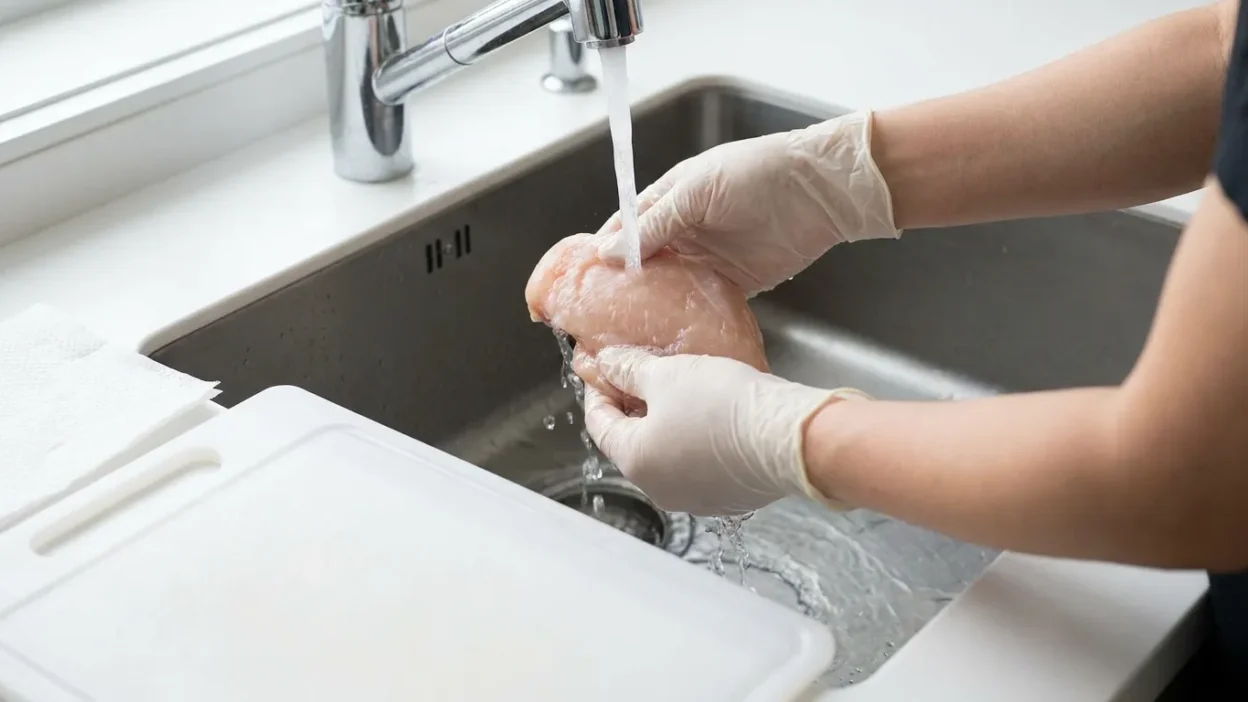
f you’ve ever stood at the sink rinsing a raw chicken breast before cooking, you’re following a habit passed down through generations — but it might be time to break it. When people search how to wash chicken, most expect a quick tutorial on rinsing technique. The real answer, according to food safety experts, is more surprising: you shouldn’t wash chicken at all.
Rather than removing bacteria like Salmonella and Campylobacter, washing raw chicken can actually spread it — splashing contaminated water across your sink, countertops, and utensils. So should you wash chicken before cooking it? Health agencies including the USDA and CDC say no, and for good reason.
In this article, we’ll break down why you shouldn’t wash chicken, what to do instead, and the safe handling steps that actually protect you and your family from foodborne illness — no rinsing required.
The Science Behind Why Washing Chicken Is Risky
To understand why you shouldn’t wash chicken, it helps to know what you’re actually dealing with. Raw poultry commonly carries Salmonella and Campylobacter — two of the leading causes of foodborne illness in the United States. These bacteria don’t sit loosely on the surface waiting to be rinsed away; they’re often bound tightly to the meat itself, which means a quick rinse under the tap does little to remove them.
What washing does accomplish is far less helpful. Studies on washing chicken bacteria transfer have found that water hitting raw poultry in the sink can splash droplets up to three feet in every direction. That spray can land on your faucet handles, nearby countertops, dish racks, sponges, and even produce sitting nearby — turning a single rinse into a kitchen-wide contamination event. This is the core issue with cross contamination raw chicken poses: you’re not eliminating risk, you’re redistributing it.
The only reliable way to kill these pathogens is heat. Cooking chicken to a safe internal temperature denatures the bacteria that water simply can’t touch. In other words, your stovetop or oven is doing the safety work — not your sink.
What Health Authorities Say
You don’t have to take this advice on faith — it’s backed by nearly every major food safety authority. The USDA raw chicken guidelines are unambiguous: the USDA’s Food Safety and Inspection Service explicitly advises against washing raw poultry, noting that rinsing does not eliminate bacteria and instead increases the risk of spreading it around the kitchen.
The CDC wash chicken guidance echoes this stance. The CDC lists washing raw meat and poultry as a common food safety mistake, pointing to cross-contamination as the primary danger rather than any benefit to hygiene.
The FDA’s Food Code — the model set of guidelines many U.S. restaurants and food service operations follow — similarly does not include rinsing raw poultry as a required or recommended safety step. Commercial kitchens are trained to go straight from package to pan, relying on proper cooking temperatures rather than pre-rinsing.
This isn’t just a U.S. position, either. The UK’s Food Standards Agency (FSA) has run public awareness campaigns specifically telling consumers not to wash raw chicken, citing the same splash-contamination research. Similar guidance appears from food safety bodies in Canada, Australia, and the EU — making this a global food safety consensus, not a regional quirk.
The takeaway: if you’re still rinsing chicken out of habit, you’re going against the near-unanimous recommendation of the agencies whose job is to prevent foodborne illness.
History: Why Do People Wash Chicken Anyway?
If washing chicken doesn’t actually make it safer, why is it still such a widespread habit? The answer has more to do with culture and instinct than food science.
For many home cooks, rinsing meat is a practice passed down from parents and grandparents — a generation that often associated “clean” with “washed,” the same way you’d rinse produce or dishes. In an era before modern refrigeration, packaging, and inspection standards were as rigorous as they are today, giving meat a rinse may have felt like a reasonable extra precaution, even if it wasn’t backed by food science.
Regional and international cooking traditions have reinforced the habit further. In many cuisines — including parts of Caribbean, Southern American, and Asian cooking — rinsing chicken with water, vinegar, lime, or salt is a long-standing step, sometimes tied as much to preparing the texture or flavor of the meat as to cleanliness. These practices are often deeply rooted in family and cultural identity, which is part of why the habit persists even as official guidance has shifted.
It’s also worth noting that food safety advice itself has evolved. Decades ago, guidance on raw meat handling was less standardized, and rinsing wasn’t as clearly flagged as a contamination risk as it is now. As research on bacterial splash-spread advanced, agencies updated their recommendations — but that updated guidance hasn’t fully caught up with everyday habits in many kitchens.
Understanding this history helps explain the gap between common practice and current science — and why breaking the habit takes a conscious effort rather than just knowing the facts.
What to Do Instead — Safe Handling Step-by-Step
Skipping the rinse doesn’t mean skipping safety — it just means putting your effort where it actually counts. Here’s the routine to follow instead of washing raw chicken:
1. Skip the Rinse
Take the chicken straight from its packaging to the cutting board or pan. There’s no food-safety benefit to running it under water first, so this step is simply removed from the process.
2. Pat It Dry, If Needed
Some recipes call for patting chicken dry before cooking to help the skin crisp or the surface brown better. This is fine to do — use a paper towel, then throw it away immediately rather than setting it down on a surface you’ll reuse.
3. Use a Dedicated Cutting Board
Keep one cutting board strictly for raw meat and a separate one for produce and ready-to-eat foods. Color-coded boards can make this easier to maintain consistently.
4. Wash Your Hands Thoroughly
After handling raw chicken, scrub your hands with soap and warm water for at least 20 seconds before touching anything else — door handles, your phone, other ingredients, all of it.
5. Sanitize Surfaces and Utensils Immediately
Any surface or tool that touched raw chicken — counters, knives, packaging — should be washed with hot, soapy water and sanitized right away, not left until after cooking.
6. Handle Storage and Thawing Safely
Store raw chicken on the bottom shelf of the fridge to prevent drips onto other foods, and thaw it in the refrigerator, cold water, or the microwave — never on the counter at room temperature.
7. Cook to the Right Internal Temperature
This is the step that actually neutralizes bacteria. Use a meat thermometer to confirm the chicken has reached 165°F (74°C) at its thickest part — this single step does more for safety than any amount of rinsing ever could.
Special Cases & Exceptions
Safe handling isn’t always one-size-fits-all. Here’s how a few common scenarios fit into the no-rinse approach.
Brining and Marinating
It’s worth distinguishing rinsing from brining or marinating. Soaking chicken in a saltwater brine or a marinade isn’t the same as washing it — the liquid isn’t being rinsed off and discarded in a way that splashes your sink. That said, any bowl, brine, or marinade that’s touched raw chicken should be treated as contaminated: discard leftover marinade or boil it thoroughly before using it as a sauce, and wash the container afterward.
Whole Chicken vs. Cut Pieces
A whole chicken carries the same splash-contamination risk as cut pieces — arguably more, since it’s bulkier and harder to maneuver over a sink without water reaching a wider area. The no-rinse rule applies equally whether you’re prepping a whole bird or individual breasts and thighs.
Frozen Chicken
There’s no need to rinse chicken during or after thawing, either. If you’re wondering whether you should wash frozen chicken before cooking, the answer is the same as for fresh: no. Thaw it safely in the fridge, cold water, or microwave, then go straight to cooking.
Cultural Acid Rinses (Vinegar, Lemon, Salt)
Many traditional recipes call for rinsing chicken with vinegar, lime juice, or salt, often for flavor or texture reasons as much as perceived cleanliness. While these acids can affect taste and texture, they aren’t strong enough or applied long enough to reliably kill bacteria like Salmonella, and the rinsing process still creates the same splash-contamination risk as plain water. If a recipe calls for this step for flavor, it’s the rinsing action — not the acid — that remains the food safety concern.
Common Myths, Debunked
Even with official guidance widely available, a few persistent myths keep the rinsing habit alive. Here’s a closer look at each one.
Myth: “Vinegar or lemon juice kills bacteria on contact.”
Acidic liquids can slow bacterial growth in some contexts, but a quick rinse or soak with vinegar or lemon juice isn’t nearly potent or prolonged enough to reliably kill pathogens like Salmonella on raw chicken. And critically, the act of rinsing still splashes contaminated liquid around your kitchen — so even if the acid had some effect on the chicken itself, the surrounding mess remains a problem.
Myth: “Washing chicken in a bowl or container prevents splashing.”
Using a bowl instead of running water under the tap reduces splash somewhat, but it doesn’t eliminate the core issue: the water still needs to be disposed of, typically down the same sink you use for food prep, and the chicken still isn’t any cleaner for having been rinsed. The bacteria remain bound to the meat regardless of the container.
Myth: “If chicken smells fine, it’s automatically safe — and if it smells off, washing will fix it.”
Smell isn’t a reliable indicator of bacterial contamination — chicken carrying Salmonella or Campylobacter can smell completely normal. Conversely, if chicken does smell off or feels slimy, that’s a sign of spoilage, and no amount of rinsing will reverse it or make it safe to eat. When in doubt, the safest move is to discard it.
Myth: “It doesn’t matter if my counters get contaminated — cooking will kill the bacteria anyway.”
Cooking kills bacteria on the chicken itself, but it does nothing for bacteria that have already splashed onto your counters, sink, or utensils. Foodborne illness often comes from this kind of secondary cross-contamination — for example, bacteria transferring from a contaminated cutting board onto a salad — rather than from undercooked meat alone.
Frequently Asked Questions
Does washing chicken with salt help remove bacteria?
No. Rubbing raw chicken with salt is a step in some traditional recipes, usually for texture or flavor, but salt applied briefly during a rinse doesn’t kill Salmonella or Campylobacter. As with vinegar or lemon juice, the rinsing action itself remains the bigger food safety concern.
What if my chicken looks slimy?
A slimy texture, dull color, or off smell are signs that chicken may have spoiled. This isn’t something rinsing can fix — if raw chicken shows these signs, the safest choice is to throw it away rather than attempt to wash it clean.
Is store-bought “pre-washed” chicken different?
Some poultry is processed with antimicrobial rinses or treatments during commercial processing, which is a controlled step different from rinsing at home in an open kitchen sink. Regardless of how chicken was processed at the plant, home cooks still shouldn’t rinse it again before cooking — the guidance applies the same way.
Can I wash chicken in a dishwasher-safe container to avoid splashing?
Using a container reduces splash somewhat, but it doesn’t address the core issue: the bacteria remain on the chicken regardless, and the wastewater still has to go somewhere — typically your sink — carrying contamination risk with it.
Does this guidance apply to other raw meats, like beef, pork, or fish?
Generally, yes. Rinsing raw beef, pork, or fish carries similar cross-contamination risks, and most food safety agencies advise against washing any raw meat before cooking. Cooking to the appropriate safe internal temperature for each type of meat remains the primary safety step.
Kitchen Safety Checklist (Quick Reference)
Save or print this list as a fast reminder next time you’re prepping chicken:
- ☐ Skip rinsing — go straight from package to cutting board or pan
- ☐ Pat dry with a paper towel if needed, then discard it immediately
- ☐ Use a cutting board reserved only for raw meat
- ☐ Keep raw chicken away from produce and ready-to-eat foods
- ☐ Wash hands with soap and warm water for 20+ seconds after handling
- ☐ Sanitize counters, knives, and surfaces immediately after contact
- ☐ Store raw chicken on the bottom shelf of the fridge
- ☐ Thaw in the fridge, cold water, or microwave — never on the counter
- ☐ Discard or fully boil any marinade that touched raw chicken
- ☐ Cook to an internal temperature of 165°F (74°C), checked with a thermometer
This same checklist applies whether you’re prepping a whole chicken, cut pieces, or previously frozen chicken.
Conclusion
The instinct to rinse raw chicken makes sense on the surface — but as the science and guidance from agencies like the USDA and CDC show, washing raw chicken does more harm than good. It doesn’t remove bacteria; it spreads it, turning your sink, counters, and utensils into potential sources of cross-contamination.
The good news is that safe chicken doesn’t require an extra step at the sink — it requires the right steps everywhere else: clean hands, dedicated surfaces, careful storage, and cooking to 165°F. Skip the rinse, follow the checklist, and you’ll be handling chicken more safely than the “clean” habit ever did.