You walk into your bedroom, catch an unmistakable whiff, and your heart sinks. Your cat has peed on your mattress. Whether you find a fresh wet patch or only notice a stubborn smell days later, knowing how to get cat pee out of a mattress quickly can mean the difference between a clean bed and a ruined one.
Unlike carpet or bedding, a mattress can’t go in the washing machine or be soaked in cleaner. Urine sinks deep into the foam and padding, and the uric acid it leaves behind keeps smelling long after the surface looks clean. That lingering scent can also draw your cat back to the same spot.
The good news is that most mattresses can be saved. In this guide, you’ll learn how to treat fresh and dried stains, which cleaners actually work, how to dry your mattress properly, and how to stop it from happening again.
Why Cat Urine Is So Hard to Remove
If you’ve ever cleaned a spot and still caught that sharp smell a day later, you’re not imagining it. Cat urine is chemically stubborn, and a mattress gives it the perfect place to hide.
What makes cat pee different
Cat urine contains urea, bacteria, and uric acid. As fresh urine dries, the urea breaks down and produces ammonia, which is the sharp smell you notice first. The uric acid is the real problem. It forms crystals that don’t dissolve in water, so ordinary soap and water can wash away the visible stain while leaving the crystals behind.
Why the smell comes back
Those crystals can sit dormant for weeks or months. When humidity rises or the area gets damp, they reactivate and release odor again. This is why a mattress can seem fine after cleaning, then smell again on a muggy day.
Why mattresses make it worse
Urine doesn’t stay on the surface. It soaks through the fabric and spreads into the foam, padding, and sometimes the springs. Since you can’t rinse or machine-wash a mattress, the liquid has nowhere to go, and surface cleaning only treats a fraction of the affected area.
Why your cat may return to the same spot
Cats have a far stronger sense of smell than we do. If any trace of urine remains, your cat may read it as a signal to go there again, which is why complete odor removal matters as much as stain removal.
The takeaway
To get cat pee out of a mattress, you need something that breaks down uric acid, not just something that covers the smell. That’s why enzymatic cleaners are such a common recommendation, and we’ll cover them in detail shortly.
Before You Start: Preparation and Safety
A few minutes of preparation will make the cleaning more effective and help you avoid damaging your mattress or yourself.
1. Strip the bed
Remove the sheets, mattress protector, pad, and any topper. Cat urine often soaks through layers, so check each one for damp spots or odor. Set these aside to wash separately.
2. Know your mattress type
The material decides how much liquid is safe to use.
- Memory foam: absorbs liquid deeply and dries slowly, so use cleaner sparingly.
- Innerspring: moisture can reach the coils, so avoid heavy soaking.
- Latex: can be damaged by harsh chemicals and heat.
- Hybrid: treat it like memory foam, and take care around the coils.
Check the care tag or the manufacturer’s website for cleaning instructions. Many warranties don’t cover liquid damage, so it’s worth knowing before you start.
3. Protect yourself and your space
- Wear rubber gloves.
- Open a window or run a fan for ventilation.
- Keep your cat out of the room so it doesn’t walk on damp areas or lick cleaning products.
- Keep any pets and children away from the cleaning products while you work.
4. Know which chemicals not to mix
- Never mix bleach with vinegar or ammonia, since this can release toxic fumes.
- Don’t combine hydrogen peroxide and vinegar in the same container.
- Avoid ammonia-based cleaners. Urine already contains ammonia, and cats may be drawn back to the smell.
5. Spot-test every cleaner
Apply a small amount to a hidden area, such as the side or bottom edge, and wait a few minutes. If you see fading, discoloration, or damage to the fabric, don’t use that product on the main stain.
6. Gather your supplies
Have everything ready before you begin so you can work while the urine is still fresh. You’ll need towels or paper towels, an enzymatic cleaner, white vinegar, baking soda, a spray bottle, a vacuum with an upholstery attachment, and a fan.
Find Every Spot
Before you clean, you need to know exactly where the urine is. Missing even one spot means the smell will linger, and your cat may come back to it. Cat urine can spread well beyond the visible stain, and old, dried urine often leaves no mark at all.
1. Use your nose first
Get close to the mattress and sniff along the surface, working in sections. The odor is usually strongest right over the affected area. Check the seams, the piping around the edges, and the sides, because urine tends to run toward them.
2. Use a UV blacklight
A blacklight is the most reliable way to find urine you can’t see.
- Wait until the room is as dark as possible.
- Hold the light a few inches above the mattress and move it slowly across the surface.
- Urine typically glows a yellowish-green color.
Keep in mind that other substances, such as some detergents, body fluids, and lint, can also glow. Treat the blacklight as a guide, and confirm with your nose.
3. Check every side of the mattress
Look at the top, sides, and bottom. If the mattress is light enough, lift it off the base or stand it on its side. Urine can soak through and show up on the underside or pool along the edges.
4. Mark each spot
Outline every area with chalk, painter’s tape, or small pieces of tape before you turn the lights back on. Once the room is bright again, the spots disappear, and you’ll want to know exactly where to treat.
5. Look for staining
Yellow or brown patches may be visible on lighter fabrics, and the fabric can feel stiff or crusty in dried areas.
Method 1: Enzymatic Cleaner (Best Overall)
If you only use one method, make it this one. Enzymatic cleaners are designed to break down the uric acid crystals that ordinary cleaners leave behind, so they remove the odor rather than just covering it.
Why it works
Enzymatic (or bio-enzymatic) cleaners contain beneficial bacteria and enzymes that digest the organic compounds in urine. Once those compounds are broken down, the smell disappears and your cat has no scent to return to. Look for a product labeled for pet urine, and avoid cleaners that contain ammonia.
For fresh stains
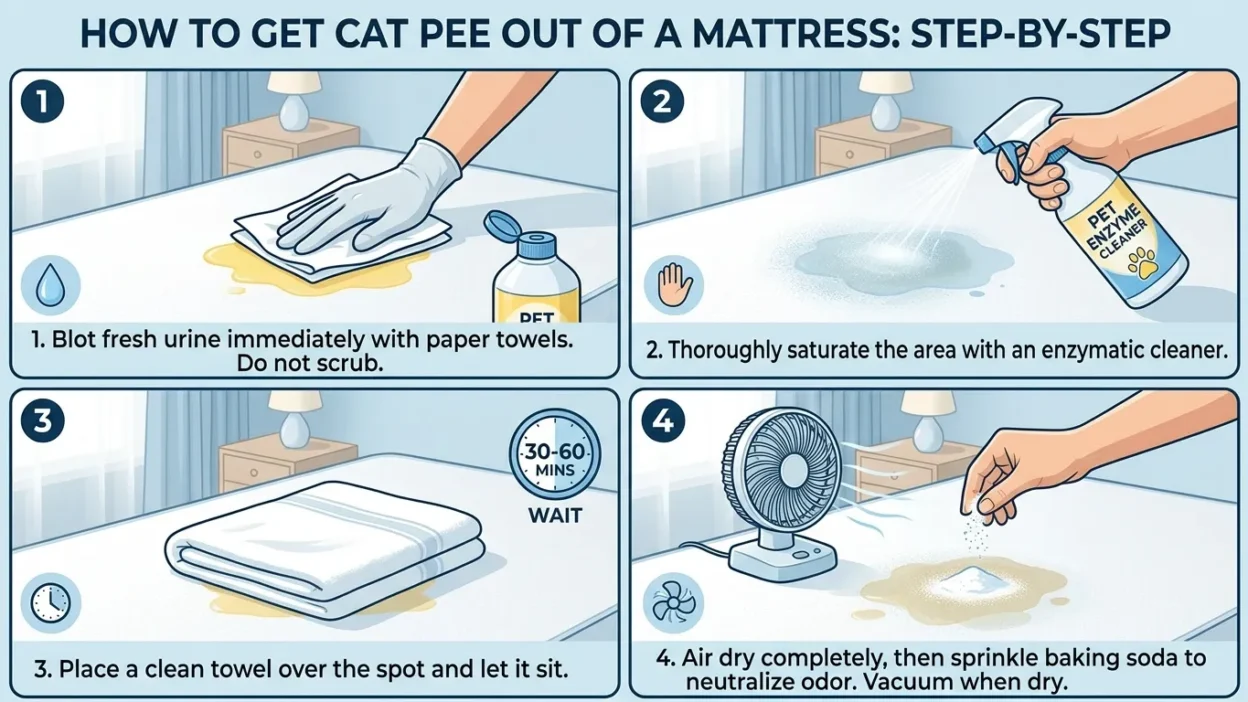
- Blot up the urine. Press clean towels or paper towels firmly into the wet spot and replace them as they soak through. Don’t rub, because rubbing pushes urine deeper into the mattress.
- Apply the cleaner generously. Urine soaks deep, so the cleaner needs to reach the same depth. Saturate the spot and a small area around it, but avoid flooding the mattress.
- Let it work. Follow the label for dwell time, which is often 10 to 15 minutes at minimum. Many products work better when the area stays damp, so don’t let it dry out too quickly.
- Blot again. Press a dry towel into the area to lift excess liquid.
- Air dry completely. Use a fan and keep the mattress uncovered until it is fully dry.
For dried stains
Dried urine needs more help, because the crystals have set into the fabric.
- Lightly dampen the stain with the cleaner to reactivate the urine.
- Apply more cleaner than you would for a fresh stain, enough to soak through to where the urine went.
- Allow a longer dwell time, up to several hours if the label allows it. Cover the spot loosely with a damp towel to slow evaporation.
- Blot, then dry thoroughly.
Tips for best results
- Don’t use other cleaners first. Vinegar, bleach, and soaps can interfere with the enzymes.
- Don’t use hot water or steam. Heat can set the stain and the smell.
- Be patient. Old stains often need two or three treatments, so allow the mattress to dry fully between rounds.
- Re-check with a blacklight once it’s dry to confirm you’ve treated every spot.
Method 2: Vinegar and Baking Soda (Budget Method)
If you don’t have an enzymatic cleaner on hand, vinegar and baking soda are a cheap, common alternative. This method works best on fresh, small accidents. It is less reliable for old or deeply soaked stains.
Why it works
White vinegar is acidic, which helps neutralize the ammonia in urine. Baking soda absorbs moisture and odor. Used together, they can reduce both the stain and the smell, though they don’t break down uric acid crystals the way enzymes do.
What you’ll need
- White vinegar
- Water
- Spray bottle
- Baking soda
- Clean towels
- Vacuum with an upholstery attachment
Step by step
- Blot first. Press clean towels into the area to soak up as much urine as possible. Don’t rub.
- Mix the solution. Combine equal parts white vinegar and water in a spray bottle.
- Spray lightly. Mist the stained area until it is damp, not soaked. Too much liquid will push urine deeper into the mattress.
- Blot again. Press a dry towel into the area to lift the moisture and loosened urine.
- Cover with baking soda. Sprinkle a thick, even layer over the whole damp spot.
- Wait 8 to 12 hours. Leave it overnight if you can, and keep the cat out of the room.
- Vacuum it up. Use the upholstery attachment to remove all the baking soda.
- Repeat if needed. If you still smell urine, run through the steps again once the mattress is dry.
Pros and cons
- Pros: very cheap, easy to find, and safe for most mattress fabrics.
- Cons: less effective on dried or old stains, and the vinegar smell can linger for a few hours.
Important notes
- Always spot-test the vinegar solution on a hidden area first.
- Never mix vinegar with bleach or hydrogen peroxide.
- Let the mattress dry fully before putting the bedding back on.
- If the smell returns after drying, switch to an enzymatic cleaner.
Method 2: Vinegar and Baking Soda (Budget Method)
If you don’t have an enzymatic cleaner on hand, vinegar and baking soda are a cheap, common alternative. This method works best on fresh, small accidents. It is less reliable for old or deeply soaked stains.
Why it works
White vinegar is acidic, which helps neutralize the ammonia in urine. Baking soda absorbs moisture and odor. Used together, they can reduce both the stain and the smell, though they don’t break down uric acid crystals the way enzymes do.
What you’ll need
- White vinegar
- Water
- Spray bottle
- Baking soda
- Clean towels
- Vacuum with an upholstery attachment
Step by step
- Blot first. Press clean towels into the area to soak up as much urine as possible. Don’t rub.
- Mix the solution. Combine equal parts white vinegar and water in a spray bottle.
- Spray lightly. Mist the stained area until it is damp, not soaked. Too much liquid will push urine deeper into the mattress.
- Blot again. Press a dry towel into the area to lift the moisture and loosened urine.
- Cover with baking soda. Sprinkle a thick, even layer over the whole damp spot.
- Wait 8 to 12 hours. Leave it overnight if you can, and keep the cat out of the room.
- Vacuum it up. Use the upholstery attachment to remove all the baking soda.
- Repeat if needed. If you still smell urine, run through the steps again once the mattress is dry.
Pros and cons
- Pros: very cheap, easy to find, and safe for most mattress fabrics.
- Cons: less effective on dried or old stains, and the vinegar smell can linger for a few hours.
Important notes
- Always spot-test the vinegar solution on a hidden area first.
- Never mix vinegar with bleach or hydrogen peroxide.
- Let the mattress dry fully before putting the bedding back on.
- If the smell returns after drying, switch to an enzymatic cleaner.
Method 3: Hydrogen Peroxide, Baking Soda and Dish Soap (For Stains)
If urine has left a yellow or brown stain on your mattress, this method can help lift it. It is better at removing discoloration than odor, so treat it as a stain remover rather than a complete solution.
Why it works
Hydrogen peroxide acts as a mild oxidizer that breaks down the compounds causing the discoloration. Baking soda adds gentle scrubbing power and absorbs odor, and dish soap helps lift the residue from the fabric.
What you’ll need
- 3% hydrogen peroxide (the standard drugstore strength)
- Baking soda
- Liquid dish soap
- A small bowl
- Clean towels or a soft cloth
- Vacuum with an upholstery attachment
Step by step
- Blot the area. Remove as much urine as you can with a clean towel.
- Mix the solution. In a small bowl, combine about 1/2 cup of hydrogen peroxide, 2 tablespoons of baking soda, and a few drops of dish soap. Stir gently.
- Apply sparingly. Spread the mixture over the stain with a cloth or spray it on lightly. Avoid soaking the mattress.
- Let it sit. Leave it for 20 to 30 minutes, until the stain begins to fade.
- Blot and wipe. Dab the area with a damp cloth to remove the residue, then blot with a dry towel.
- Dry and vacuum. Let the area dry completely, then vacuum off any leftover baking soda.
Warnings
- Spot-test first. Peroxide can bleach or fade dark and dyed fabrics, so test a hidden spot and wait a few minutes.
- Mix it fresh. Use the solution right away. Don’t store it in a sealed container, because pressure can build up.
- Never combine it with vinegar. The mixture can create a corrosive acid.
- Follow up for odor. Because this method doesn’t reliably break down uric acid, treat the area with an enzymatic cleaner afterward if any smell remains.
Best for
Visible stains on light-colored mattress fabric, as a second step after odor treatment.
Which Method Should You Use? A Side-by-Side Comparison
Each method has its strengths. This table makes it easier to pick the right one for your situation.
| Enzymatic cleaner | Vinegar + baking soda | Peroxide + baking soda + dish soap | |
|---|---|---|---|
| Best for | Fresh and old urine, deep odor | Fresh, small accidents | Visible yellow or brown stains |
| Removes odor? | Yes, breaks down uric acid | Partly, but may return | Partly, not reliable |
| Removes stain? | Mostly | Partly | Yes |
| Works on dried urine? | Yes, with extra saturation | Limited | Limited |
| Cost | Medium | Low | Low |
| Risk to fabric | Low | Low | Can bleach dark or dyed fabric |
| Drying time | Moderate to long | Moderate | Short to moderate |
| Number of treatments | 1-3 | 1-2 | 1-2 |
How to choose
- Fresh accident and no special cleaner at home: start with vinegar and baking soda.
- Old, dried, or deeply soaked urine: go straight to an enzymatic cleaner.
- Stain still visible after odor treatment: follow up with the peroxide mixture, once you’ve confirmed the fabric is colorfast.
- Smell keeps returning: use an enzymatic cleaner, since it’s the only option that targets the uric acid crystals.
Combining methods
You can use more than one method, but order matters. Use an enzymatic cleaner first for odor, let the mattress dry completely, then treat any leftover stain with the peroxide mixture. Don’t apply other cleaners right before the enzymatic cleaner, because they can weaken the enzymes. Never mix products in the same container or on the same wet area.
Special Mattress Types: How to Adjust Your Cleaning
The basic steps are the same for every mattress, but the material affects how much liquid is safe to use, how long drying takes, and which products are risky. Check the manufacturer’s care instructions first.
Memory foam
Memory foam soaks up liquid like a sponge and dries slowly, so trapped moisture is the biggest risk.
- Use less cleaner than you would on other mattresses, and apply it in light layers.
- Blot firmly and repeatedly to pull liquid out of the foam.
- Allow extra drying time, often a full day or more, with a fan running.
- Avoid heat, which can damage the foam.
Innerspring
The fabric and padding on top are easy to treat, but moisture that reaches the coils can cause rust and odor.
- Avoid soaking the mattress.
- Use a fan to dry it thoroughly.
- If urine has soaked all the way through, check the underside as well.
Latex
Latex is durable but sensitive to harsh chemicals and heat.
- Stick to mild, pet-safe enzymatic cleaners.
- Avoid bleach and strong solvents.
- Dry it away from direct heat or intense sunlight, which can break the material down.
Hybrid
Hybrids combine foam layers with coils, so treat them like memory foam on top and take the same care around the coils. Dry them especially well.
Pillow-top and mattress toppers
Pillow-tops hold urine in their stuffing, which makes odor harder to remove. A removable topper is the easier case, because you can treat it separately and dry it on its own. Check the care tag to see whether it can be machine-washed.
Airbeds and waterbeds
Materials vary, so follow the manufacturer’s guidance. Many have a vinyl surface that wipes clean more easily than fabric.
Cleaning the Bedding, Topper, and Mattress Protector
Treating the mattress is only half the job. If the sheets, pad, or protector still smell like urine, the odor will come right back, and your cat may be drawn to the bed again.
1. Remove excess urine first
Shake off or scrape away any solids, and blot any wet fabric before washing. If an item is badly soiled, rinse it in cool water first. Cool water is better than hot at this stage, since heat can set urine proteins into the fibers.
2. Use an enzymatic laundry additive
Add an enzymatic cleaner or a pet-odor laundry product to the wash, following the label for dosage. Regular detergent alone may leave uric acid behind. For heavily affected items, you can soak them in the enzyme solution for 30 minutes to a few hours before washing.
3. Wash on the warmest setting the label allows
Check each care tag. Sheets and cotton items usually tolerate warm or hot water, while protectors, toppers, and delicate fabrics may need cooler settings. A second rinse cycle can help remove leftover residue.
4. Don’t add products that interfere
- Skip fabric softener on waterproof protectors, because it can reduce their performance.
- Avoid bleach unless the care label allows it and the fabric is white.
- Never use ammonia-based products.
5. Sniff before you dry
Machine heat can lock in any leftover odor. Smell each item once it’s washed. If it still smells like urine, wash it again with the enzymatic additive, or air dry it and re-check. Only use the dryer once the smell is gone.
6. Dry fully
Hang items outdoors in the sun if possible, since sunlight helps with odor. Otherwise, use a dryer on the setting the label recommends.
7. Check pillows and comforters
Urine can seep into pillows, duvets, and blankets. Wash them using the same method, and make sure they dry completely to prevent mildew.
Drying the Mattress Properly
Many guides skip this step, but it can make or break your cleaning. A mattress that stays damp can develop mold, mildew, and a musty smell that is just as unpleasant as the urine. Foam and padding can hold moisture deep inside, so surface dryness isn’t enough.
1. Blot out as much moisture as possible
Before you start drying, press clean, dry towels firmly into the treated area until they come away barely damp. The less liquid left in the mattress, the faster it dries.
2. Increase airflow
- Aim a fan directly at the treated spot.
- Open windows or doors to circulate air.
- Run a dehumidifier in the room if you have one, especially in humid weather.
- If you can, stand the mattress on its side so air reaches both surfaces.
3. Use sunlight carefully
Sunlight can help freshen a mattress and reduce odor, so if you can move it outdoors, a few hours on a dry, sunny day is a good option. Keep in mind that prolonged direct sun can fade fabric and may damage foam or latex, so don’t leave it out all day.
4. Avoid direct heat
Don’t use a hair dryer on a high setting, a heater, or a heated blanket. Heat can damage foam and set any remaining odor.
5. Test for dampness
Press a dry white towel firmly into the spot and hold it for a few seconds. If it picks up any moisture, keep drying. Also check whether the area feels cooler than the rest of the mattress, since dampness can feel cool to the touch.
6. Be patient
Drying can take anywhere from several hours to a couple of days, depending on the mattress type, how much liquid was used, and the humidity.
7. Wait before remaking the bed
Don’t put sheets or a protector back on until the mattress is completely dry. Covering a damp mattress traps moisture and encourages mold.
Removing Stubborn or Old Odors
Sometimes the stain is gone, but the smell hangs on. This usually means urine is still trapped deep in the mattress, or you missed a spot. Don’t give up yet, because persistence often pays off.
1. Repeat the enzymatic treatment
Old odors rarely disappear after one round. Saturate the area again with an enzymatic cleaner, let it work for the full dwell time on the label, then blot and dry completely. Two or three rounds are common for set-in urine. Let the mattress dry fully between treatments so you can tell whether the smell is really gone.
2. Re-check with a blacklight
Go over the whole mattress again in a dark room. You may find spots you missed the first time, such as along the seams, on the sides, or on the underside.
3. Treat deeper
If urine soaked through, surface treatment won’t reach it. Apply more cleaner, in light layers rather than one flood, so it can travel down to where the urine went. Take care not to over-wet the mattress, especially memory foam.
4. Use baking soda between treatments
Sprinkle a thick layer of baking soda over the area and leave it for 8 to 12 hours, then vacuum it up. It absorbs odor and moisture while you wait for the next round.
5. Flip or rotate the mattress
If the manufacturer allows it, flip the mattress and check the other side for missed spots. Many modern mattresses are one-sided and shouldn’t be flipped, so check the care tag first.
6. Air it out
Fresh air and low humidity help. Keep the room ventilated, and use a dehumidifier in damp weather, since humidity can reactivate leftover uric acid.
7. Use rental extractors with caution
A carpet or upholstery extractor can pull liquid out of a mattress, but it’s easy to over-wet. Use it sparingly, with enzymatic solution, and only if the care instructions allow it.
8. Skip the cover-ups
Scented sprays, perfumes, and air fresheners only mask the smell, and they can encourage your cat to re-mark the spot.
When to Call a Professional or Replace the Mattress
Most cat pee accidents can be fixed at home, but some situations call for outside help or a new mattress. Knowing when to stop saves you time, effort, and sleepless nights.
Signs it’s time to call a professional
- The smell persists after three or more enzymatic treatments.
- The urine has soaked through the whole mattress, or you’ve found multiple affected areas.
- You’ve treated the mattress several times and your cat keeps returning to it.
- The mattress is expensive, or a type you’re hesitant to treat yourself.
Professional upholstery or mattress cleaners have commercial extraction equipment and stronger treatments, and they can reach deep into the mattress. Ask whether they have experience with pet urine, and get a price in advance. Some will also tell you honestly if the mattress can’t be saved.
Signs it’s time to replace the mattress
- Mold or mildew: black, green, or fuzzy spots, or a musty smell that doesn’t go away.
- Repeated heavy soaking: urine that has reached the foam core or springs several times over.
- A persistent odor: the smell returns after professional cleaning.
- Age and condition: the mattress is already old, sagging, or near the end of its life.
- Health concerns: if you or someone in your home has allergies, asthma, or breathing sensitivities that flare up around the mattress.
Weigh the cost
Compare the cost of professional cleaning against the price of a replacement. If cleaning costs a large share of a new mattress, replacing it may make more sense, especially for an older one.
Check your warranty and insurance
Most mattress warranties exclude stains and liquid damage, but it’s worth reading the terms. Renters should also check their lease and talk to their landlord if the mattress isn’t theirs.
Protect the next one
If you do replace it, start with a waterproof mattress protector from day one, and address the reason your cat peed there (covered in a later section).
Common Mistakes to Avoid
Even a good cleaning plan can fail if you make one of these errors. Knowing what not to do can save your mattress.
1. Rubbing instead of blotting
Scrubbing pushes urine deeper into the foam and spreads the stain. Press firmly with a clean towel and lift straight up.
2. Using hot water or steam
Heat can bond the proteins in urine to the fibers and lock in the smell. Stick to cool or lukewarm water, and don’t use a steam cleaner on the mattress.
3. Using ammonia-based cleaners
Urine already contains ammonia, so an ammonia cleaner can smell like another cat’s marking to your pet and invite repeat accidents. Check product labels before you buy.
4. Over-saturating the mattress
More liquid doesn’t mean a better clean. A soaked mattress takes days to dry and can grow mold. Apply cleaner in light layers and blot between them.
5. Skipping the blacklight search
If you only treat the spots you can see, you’ll miss others. Untreated urine keeps smelling and draws your cat back.
6. Putting bedding back too soon
Covering a damp mattress traps moisture and encourages mildew. Make sure it’s completely dry first.
7. Mixing cleaning products
Combining bleach with vinegar or ammonia can release toxic fumes. Peroxide and vinegar together can form a corrosive acid. Use one product at a time and rinse or blot between them.
8. Using other cleaners before the enzyme cleaner
Soaps, vinegar, and bleach can interfere with enzyme activity, so apply the enzymatic cleaner first.
9. Masking the smell with fragrance
Air fresheners and scented sprays cover the odor without removing it, and the scent can encourage re-marking.
10. Skipping the spot test
Peroxide and some cleaners can fade or stain fabric. Test a hidden area first.
11. Ignoring the cause
If you clean the mattress but don’t find out why your cat peed there, it will probably happen again.
Why Is My Cat Peeing on My Bed?
Cleaning the mattress solves today’s problem, but finding the cause is what stops it from happening again. Cats rarely pee outside the litter box out of spite. It’s usually a sign that something is wrong, and your bed, which smells strongly of you, can feel like a safe or comforting place to go.
1. Medical problems
This should be your first suspicion, especially if the behavior is new or sudden. Conditions that can cause accidents include:
- Urinary tract infections
- Bladder stones or crystals
- Kidney disease
- Diabetes
- Arthritis, which can make climbing into a litter box painful
Signs to watch for include straining to pee, frequent trips to the box, small amounts of urine, blood in the urine, crying while urinating, or excessive licking of the genital area. Male cats with straining or no urine output need a vet immediately, because a urinary blockage is an emergency.
2. Litter box problems
Cats are picky about their bathrooms. Common issues include:
- A dirty box (scoop at least once a day)
- Too few boxes (a common guideline is one per cat, plus one extra)
- A box that is too small or has high sides
- A new litter type or scent the cat dislikes
- A box in a noisy, busy, or hard-to-reach spot
3. Stress and anxiety
Changes at home can unsettle a cat. Triggers include a new pet or baby, moving house, a change in your schedule, construction noise, or conflict with another cat. Peeing on your bed may be a way of mixing your scent with their own for comfort.
4. Territorial marking
Spraying or marking is more common in unneutered cats, but neutered cats can do it too, especially in multi-cat homes. Marking often involves a small amount of urine on a vertical or prominent surface, though beds are also targeted.
5. Age-related changes
Older cats may have cognitive decline or trouble getting to the box in time.
When to see a vet
If your cat is peeing on the bed repeatedly, or you notice any of the signs above, book a vet visit before assuming it’s behavioral.
How to Prevent It From Happening Again
Once the mattress is clean, the next goal is making sure it stays that way. Prevention usually combines protecting the bed with fixing whatever led your cat to pee there in the first place.
1. Use a waterproof mattress protector
A good protector is your best insurance. Choose one that is fully waterproof and covers the sides of the mattress, not just the top. Put a washable cover or sheet over it, and keep a spare so you can change the bed quickly after an accident.
2. Keep the bedroom door closed
If your cat can’t get in, it can’t pee on the bed. This is an easy short-term fix while you work on the underlying cause. Use it alongside the other steps, not as a replacement for them.
3. Improve the litter box setup
- Scoop at least once a day, and wash the box regularly with mild, unscented soap.
- Provide one box per cat, plus one extra.
- Place boxes in quiet, easy-to-reach spots, away from food and water.
- Choose a large box with low sides, especially for kittens and older cats.
- Avoid changing litter brands suddenly, and avoid heavily scented litters.
4. Reduce stress
- Keep feeding and play times consistent.
- Give your cat plenty of enrichment, such as scratching posts, perches, and toys.
- Provide hiding places and high spots, particularly in multi-cat homes.
- Introduce changes, such as new pets or furniture, gradually.
- Consider a feline pheromone diffuser. Results vary from cat to cat.
5. Clean accidents completely
Always use an enzymatic cleaner on any accident, on the bed or elsewhere, so no scent remains to attract your cat back.
6. Make the bed less appealing
Some owners place a temporary barrier, such as plastic sheeting under a blanket, or a cat-safe deterrent. Avoid ammonia-based or strongly scented products.
7. Reward good habits
Praise or give treats when your cat uses the litter box. Never punish accidents, because it increases stress and can make the problem worse.
8. Talk to your vet
If the problem continues despite these changes, ask your vet about medical causes or a referral to a cat behavior specialist.
Frequently Asked Questions
Does vinegar get cat pee out of a mattress?
Vinegar can help with fresh urine. Its acidity neutralizes some of the ammonia and reduces the smell. It doesn’t break down uric acid crystals, though, so odor may return, especially with old or deep stains. For lasting results, use an enzymatic cleaner.
Does baking soda remove cat urine smell?
Baking soda absorbs moisture and odor, which makes it a useful helper. On its own, it rarely removes cat urine smell completely. Use it after blotting and cleaning, leave it for 8 to 12 hours, then vacuum it up.
Can I use bleach on a mattress with cat pee?
It’s best to avoid bleach. It can damage and discolor mattress fabric, and it doesn’t remove the uric acid that causes lasting odor. Bleach also reacts dangerously with ammonia, which is present in urine, and with vinegar. Choose an enzymatic cleaner instead.
How do you get dried cat pee out of a mattress?
Find the spot with a blacklight, then lightly dampen it and apply an enzymatic cleaner generously. Let it sit for the full time on the label, keeping the area damp, then blot and dry completely. Old stains often need two or three treatments.
How long does cat pee smell last on a mattress?
Untreated, it can last for months or longer, and it may come back in humid weather. Once the urine is fully broken down with an enzymatic cleaner and the mattress is dry, the smell should disappear within a day or two.
Is it safe to sleep on a mattress after cleaning cat urine?
Yes, once it is completely dry and any cleaning product smell has faded. Sleeping on a damp mattress can lead to mold and mildew. Check for dampness by pressing a dry towel into the area before you remake the bed.
Will cat pee ruin a memory foam mattress?
Not necessarily. Memory foam absorbs liquid deeply and dries slowly, so it’s harder to treat, but it can often be saved with prompt blotting, light layers of enzymatic cleaner, and thorough drying. Very old or deeply soaked urine may be harder to remove.
Can you use a steam cleaner on a mattress with cat urine?
It’s best not to. Heat can bind urine proteins to the fibers and lock in the odor, and steam adds moisture that can be hard to dry out of the mattress. Use cool to lukewarm water and enzymatic cleaner instead.
Why does my mattress still smell after cleaning?
Common reasons include missed spots, urine that soaked deeper than the cleaner reached, or leftover uric acid crystals. Re-check with a blacklight, repeat the enzymatic treatment, and make sure the mattress dries fully between rounds.
Conclusion
Finding cat pee on your mattress is frustrating, but it doesn’t have to mean throwing the bed away. The key steps are simple: blot the urine, find every spot with a blacklight, treat it with an enzymatic cleaner that breaks down uric acid, and dry the mattress completely before remaking the bed. Old stains may take a few rounds, so be patient and avoid shortcuts like hot water, ammonia cleaners, or scented sprays.
Cleaning is only half the solution. Protect your next mattress with a waterproof cover, and find out why your cat chose the bed. If it keeps happening, a vet visit and a few litter box changes can make a big difference.
Have a tip that worked for you? Share it in the comments, or read our related guide on removing cat urine from carpet.