Few words send confident cooks and casual conversationalists into a stammering spiral quite like Worcestershire. You’ve seen it on the bottle a hundred times, sitting right next to the Bloody Mary mix or drizzled into your favorite marinade — yet the second you try to say it out loud, something goes wrong. Is it “wor-CESS-ter-shire”? “War-chester-shire”? Whatever awkward sound comes out, you can usually tell by the listener’s face that you didn’t quite nail it.
Here’s the good news: Worcestershire pronunciation is nowhere near as complicated as the spelling suggests. In fact, the “trick” is that most of the letters you see simply aren’t pronounced at all. Once you know the shortcut, you’ll never hesitate over this word again.
In this guide, we’ll break down exactly how to pronounce Worcestershire, where the word comes from, and how to avoid the most common mistakes.
The Quick Answer
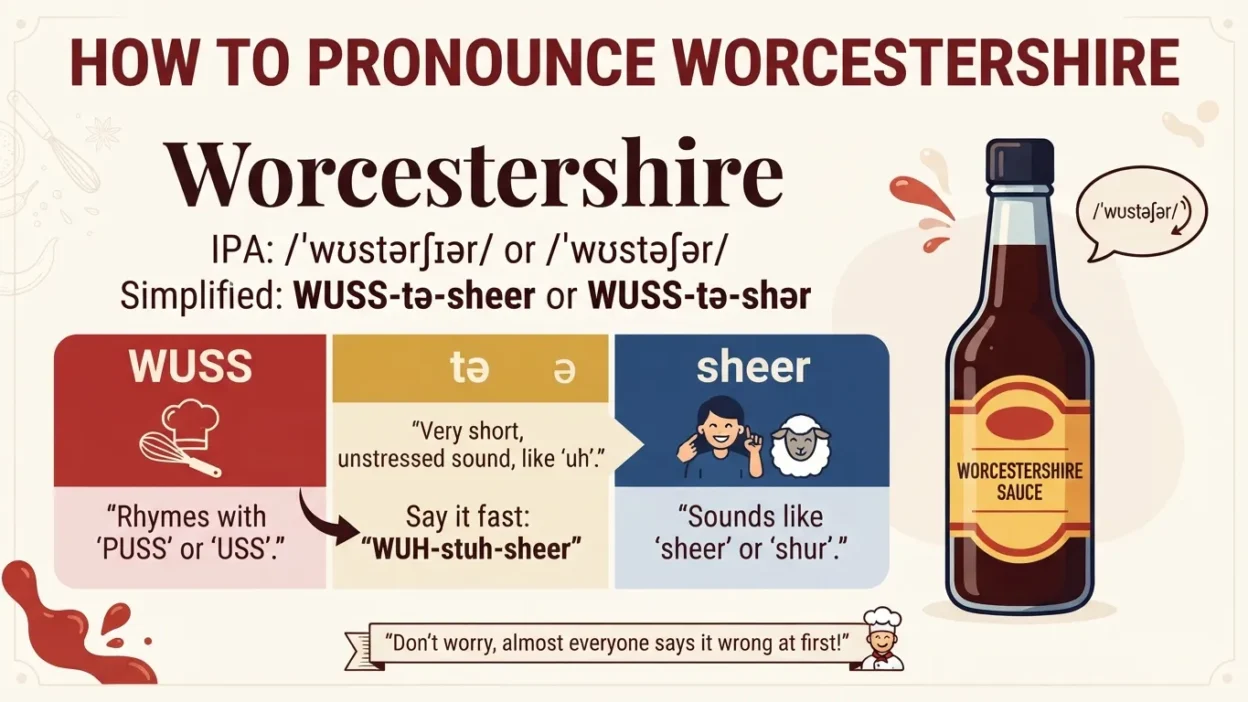
Let’s cut straight to it: Worcestershire is pronounced WUSS-ter-sher.
Say it slowly and it breaks down into three simple chunks:
- WUSS (rhymes with “puss”)
- ter (a quick, unstressed “tuh” sound)
- sher (like the end of “usher”)
Put them together and you get WUSS-ter-sher — not four or five syllables, just three. Americans sometimes stretch the final syllable slightly into “shire,” giving you WUSS-ter-shire, but the core sound stays the same on both sides of the Atlantic.
The biggest surprise for most people: the letters “ces” in the middle of the word basically vanish. You don’t say “sess,” you don’t say “chester” — that whole middle chunk collapses into a soft, barely-there “ter” sound.
If you remember nothing else from this article, remember this: fewer sounds than letters. That one rule will get you through 90% of the confusion.
Why It’s So Confusing
If Worcestershire feels like a trap, that’s because it kind of is. English spelling often assumes you’ll sound out every letter, but Worcestershire breaks that rule almost entirely — the written word and the spoken word barely resemble each other.
This isn’t a one-off quirk. It’s a pattern found across a whole category of British place names, especially ones ending in “-cester” or “-shire.” Take Leicester (pronounced “LES-ter”), Gloucester (“GLOSS-ter”), or Towcester (“TOH-ster”) — in every case, a chunk of letters in the middle gets swallowed whole. Worcestershire just happens to be the most famous example, mostly because it’s plastered across a sauce bottle in nearly every kitchen in the English-speaking world.
There’s a historical reason for this mismatch. Many English place names evolved their pronunciation over centuries of casual, spoken use, while the spelling stayed frozen — often reflecting Old English or Latin roots rather than how people actually said the word day to day. The result: spelling that’s essentially a fossil, and pronunciation that took its own, shorter path.
Add to that the fact that Worcestershire isn’t just a county — it’s also a globally exported condiment brand name — and you’ve got a word millions of non-British speakers encounter in print long before they ever hear it spoken aloud. No wonder it trips people up.
Why It’s So Confusing
If Worcestershire feels like a trap, that’s because it kind of is. English spelling often assumes you’ll sound out every letter, but Worcestershire breaks that rule almost entirely — the written word and the spoken word barely resemble each other.
This isn’t a one-off quirk. It’s a pattern found across a whole category of British place names, especially ones ending in “-cester” or “-shire.” Take Leicester (pronounced “LES-ter”), Gloucester (“GLOSS-ter”), or Towcester (“TOH-ster”) — in every case, a chunk of letters in the middle gets swallowed whole. Worcestershire just happens to be the most famous example, mostly because it’s plastered across a sauce bottle in nearly every kitchen in the English-speaking world.
There’s a historical reason for this mismatch. Many English place names evolved their pronunciation over centuries of casual, spoken use, while the spelling stayed frozen — often reflecting Old English or Latin roots rather than how people actually said the word day to day. The result: spelling that’s essentially a fossil, and pronunciation that took its own, shorter path.
Add to that the fact that Worcestershire isn’t just a county — it’s also a globally exported condiment brand name — and you’ve got a word millions of non-British speakers encounter in print long before they ever hear it spoken aloud. No wonder it trips people up.
British vs. American Pronunciation
Here’s some reassuring news: Worcestershire is pronounced almost the same way on both sides of the Atlantic. There’s no dramatic British-vs-American showdown here — just a few subtle differences in accent and emphasis.
British English: WUSS-tuh-sher
British English is largely non-rhotic, meaning the “r” sounds are softened or dropped almost entirely. So the “r” after “Wor” barely registers, and the ending “-shire” comes out as a light, quick “-sher.” The whole word flows together smoothly and briskly — Brits tend to say it fast, almost clipping it.
American English: WUSS-ter-sher (sometimes WUSS-ter-shire)
American English is rhotic, meaning Americans do pronounce the “r” sounds more distinctly. So the middle “r” gets a touch more presence, and some Americans stretch the final syllable slightly toward “-shire” rather than the clipped British “-sher.” It’s a small difference, but it’s there if you listen closely.
The bottom line: Whether you say “WUSS-tuh-sher” or “WUSS-ter-sher,” you’re correct. Native speakers on both sides will understand you immediately — the real mistake isn’t a slight accent variation, it’s sounding out all those extra letters in the middle.
Ready for the next section — “A Brief History of the Word”?
A Brief History of the Word
To understand why Worcestershire is pronounced so differently from how it’s spelled, it helps to know where the word actually comes from.
Worcestershire is a real county in England, located in the West Midlands. Like most English counties ending in “-shire” (Yorkshire, Cheshire, Derbyshire), the name combines a place name — Worcester — with the suffix “-shire,” which simply means “county” or “district” in Old English. So Worcestershire literally means “the county of Worcester.”
The city of Worcester itself has roots going back over a thousand years, with a name derived from Old English and even earlier Celtic and Latin influences tied to the Roman settlement in the area. Centuries of spoken evolution smoothed the pronunciation down to “Wuss-ter,” even as the spelling stayed anchored to its older, more complex form.
So how did the sauce get involved? In the 1830s, two chemists — John Wheeley Lea and William Henry Perrins — developed a fermented condiment recipe in the city of Worcester. They named it Worcestershire Sauce after the county, and it quickly became a global export. Because the sauce reached kitchens worldwide long before most people ever heard a British person say the word aloud, generations of cooks encountered “Worcestershire” only in writing — which is a big reason the mispronunciation became so widespread in the first place.
In short: the word isn’t strange by accident. It’s the product of centuries of spoken language evolving faster than written spelling ever could.
Memory Tricks to Never Mispronounce It Again
Knowing the correct pronunciation is one thing — remembering it under pressure (like ordering a Bloody Mary or reading a recipe aloud) is another. Here are a few tricks to make WUSS-ter-sher stick for good.
1. Anchor it to a word you already know
Think of “Wuss” as in a soft push — like the word “push” itself. That first syllable is the one people overcomplicate the most, so locking it in solves half the battle.
2. Use the “three beats” trick
Instead of thinking of it as one long word, clap or tap out three short beats: WUSS (beat) ter (beat) sher (beat). Treating it like a tiny rhythm rather than a spelling exercise bypasses the instinct to sound out every letter.
3. Picture the silent middle
Mentally cross out the letters C-E-S in the middle of the word. If you simply never “see” them when reading it, you’ll never be tempted to pronounce them.
4. Borrow from familiar cousins
If you already comfortably say Leicester (“Les-ter”) or Gloucester (“Gloss-ter”), lean on that same mental pattern — Worcestershire follows the identical logic, just with an extra “-shire” tacked on.
5. Repeat it in context, not isolation
Say the full phrase you’d actually use — “a splash of Worcestershire sauce” — five times fast. Practicing it in a sentence builds the muscle memory better than repeating the word alone.
With even one of these tricks in your back pocket, the word stops being a linguistic landmine and starts being second nature.
Common Mispronunciations (What NOT to Say)
Even with the correct answer in hand, it helps to know exactly which versions to avoid — and why they happen in the first place. Here are the most common ways people get tripped up:
❌ “wor-CESS-ter-shire”
This is the most frequent mistake, and it makes total sense — it’s exactly what the spelling suggests. But that middle “cess” sound should almost completely disappear. Saying it fully is the number-one giveaway of a first-timer.
❌ “wor-CHESTER-shire”
This happens because “cester” visually resembles “chester” (as in Manchester or Chester). It’s a reasonable guess, but the “ces” doesn’t get a hard “ch” sound here — it just softens into that quick “ter.”
❌ “wor-ses-ter-SHY-er”
Stretching out the final syllable into a full “shy-er” (like “buyer”) over-pronounces the ending. It should stay short and clipped — “sher,” not “shy-er.”
❌ Sounding out all four “syllables” as written
Treating it like Wor-ces-ter-shire — four distinct, evenly-weighted syllables — is the root issue behind almost every mispronunciation on this list. The word simply doesn’t work that way out loud.
Why these mistakes happen: English speakers are trained to sound out unfamiliar words phonetically, letter by letter. Worcestershire actively punishes that instinct, because so much of its spelling reflects history rather than modern speech. The fix isn’t about phonics — it’s about memorizing the sound shape of the word, independent of how it looks on the page.
Other English Words/Places With the Same Trap
Once you understand the logic behind Worcestershire, you’ll start noticing the same pattern everywhere in English place names. Many of these words follow an identical rule: middle syllables get swallowed, and the spelling never caught up.
Leicester → pronounced “LES-ter”
Just like Worcestershire, the “ces” collapses down to almost nothing. Home of Leicester City football club and a frequent stumbling block for anyone new to British geography.
Gloucester → pronounced “GLOSS-ter”
Another county name where the middle vanishes almost entirely. The “glou” becomes a quick “gloss,” and the rest disappears.
Edinburgh → pronounced “ED-in-bruh”
Not spelled anything like it sounds — the “burgh” ending softens to “bruh,” not “burg” or “burrow.”
Towcester → pronounced “TOH-ster”
A smaller town, but the same rule applies: “cester” reduces down to a simple “ster.”
Cirencester → pronounced “SY-ren-ster” (or sometimes “SIS-eter” locally)
One of the more extreme examples — nearly half the written word disappears in speech.
Warwick → pronounced “WOR-ick”
The “w” in the middle is completely silent, much like the hidden letters in Worcestershire.
The pattern to remember: Whenever you see “-cester” in an English place name, expect it to shrink down to a simple “-ster” sound. It’s not a random exception — it’s a consistent (if unwritten) rule across dozens of English towns and counties.
Bonus: What Is Worcestershire Sauce, Anyway?
Now that you can say it correctly, it’s worth knowing exactly what you’re asking for.
Worcestershire sauce is a fermented, savory condiment with a distinctive tangy, umami-rich flavor. It’s typically made from a blend of:
- Vinegar
- Molasses
- Sugar
- Anchovies
- Tamarind extract
- Onions and garlic
- A mix of spices
The combination produces a flavor that’s simultaneously sour, sweet, salty, and deeply savory — which is exactly why a few dashes go such a long way in a recipe.
A bit of origin story: The sauce was first developed in the 1830s by two chemists, John Wheeley Lea and William Henry Perrins, working in the city of Worcester, England. As the story goes, an early batch was left forgotten in a cellar for months — and when rediscovered, it had fermented into something far more complex and delicious than intended. The recipe was refined and eventually sold commercially as Lea & Perrins Worcestershire Sauce, which remains one of the most recognized brand names in the condiment aisle today.
How it’s commonly used:
- Splashed into a Bloody Mary for depth and kick
- Stirred into marinades for steak, chicken, or pork
- Added to Caesar dressing (it’s a traditional ingredient!)
- Used as a secret flavor booster in stews, chili, and gravies
- A dash in Welsh rarebit or cheese-based sauces
So next time you reach for that bottle, you’ll not only know exactly what’s in it — you’ll be able to say its name with total confidence.
Conclusion
At the end of the day, Worcestershire isn’t nearly as intimidating as its spelling makes it look. Strip away the extra letters, and you’re left with a simple, three-beat word: WUSS-ter-sher.
To recap:
- The correct pronunciation is WUSS-ter-sher (or WUSS-ter-shire in some American accents)
- The middle “ces” is essentially silent — don’t sound it out
- It follows the same pattern as other English place names like Leicester and Gloucester
- Both British and American pronunciations are close enough that either will be understood
- The word gets its name from the English county of Worcestershire, home to the original Lea & Perrins sauce
The next time you’re reaching for that bottle in the kitchen, ordering a Bloody Mary, or just reading a recipe out loud, you’ll say it with total confidence instead of stumbling through it.
Give it a try right now — say it out loud three times: WUSS-ter-sher, WUSS-ter-sher, WUSS-ter-sher. See? Not so scary after all.
Got a word that trips you up just as much as this one? Drop it in the comments — it might just be the topic of our next pronunciation guide.