If you’ve just had surgery, a dental extraction, or a wound stitched up, you’ve probably noticed something reassuring: no follow-up visit needed to remove the stitches. That’s because dissolvable stitches are designed to disappear on their own as your body heals. But that raises an obvious question — how long do dissolvable stitches take to dissolve?
The answer isn’t one-size-fits-all. For most people, dissolvable stitches dissolve within one to two weeks, but depending on the suture material, wound location, and your body’s healing pace, the process can stretch to several weeks or even a few months. Understanding what’s normal — and what isn’t — can help you feel more confident during recovery instead of second-guessing every itch or tug you feel near the wound.
In this guide, we’ll break down exactly what affects dissolving time, what to expect at each stage, and when it’s worth calling your doctor.
What Are Dissolvable Stitches?
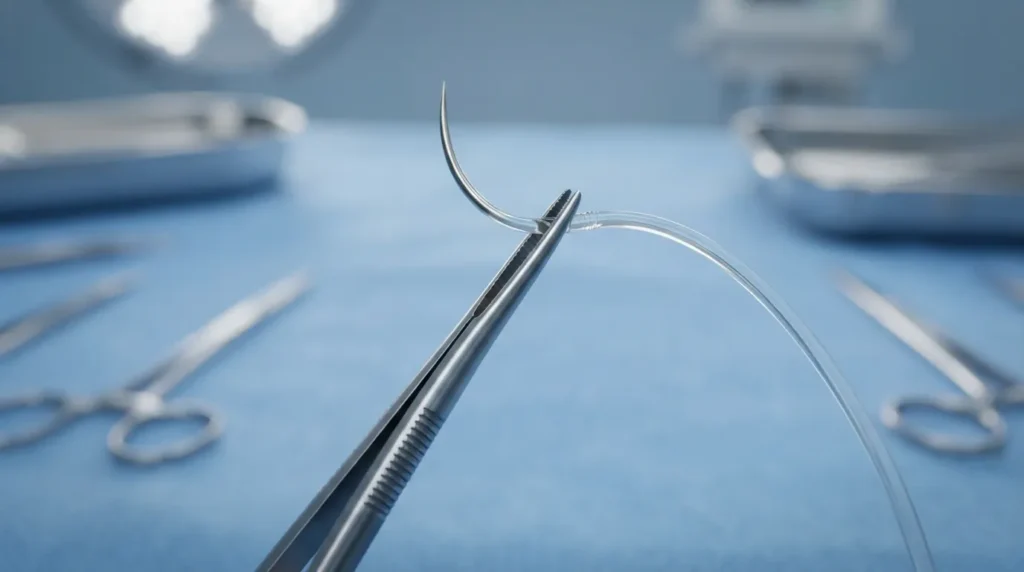
Dissolvable stitches, also called absorbable sutures, are surgical threads made from materials your body can naturally break down over time — no removal appointment required. Unlike non-dissolvable stitches (typically made of silk, nylon, or polyester), which stay put until a doctor snips them out, dissolvable stitches are designed to weaken and disappear as your tissue heals underneath.
This breakdown happens through two main processes, depending on the material: hydrolysis, where the suture slowly absorbs moisture and breaks apart, or enzymatic digestion, where the body’s natural enzymes gradually dissolve the material. Either way, the suture loses tensile strength over time until it’s fully absorbed.
Because they don’t require extraction, dissolvable stitches are especially useful for wounds that are hard to access — like internal surgical sites or deep tissue repairs — as well as everyday uses such as skin lacerations, surgical incisions, and dental extractions.
Not all dissolvable stitches are the same, though. The material used plays a major role in how long they last, which we’ll cover next.
Types of Dissolvable Suture Materials
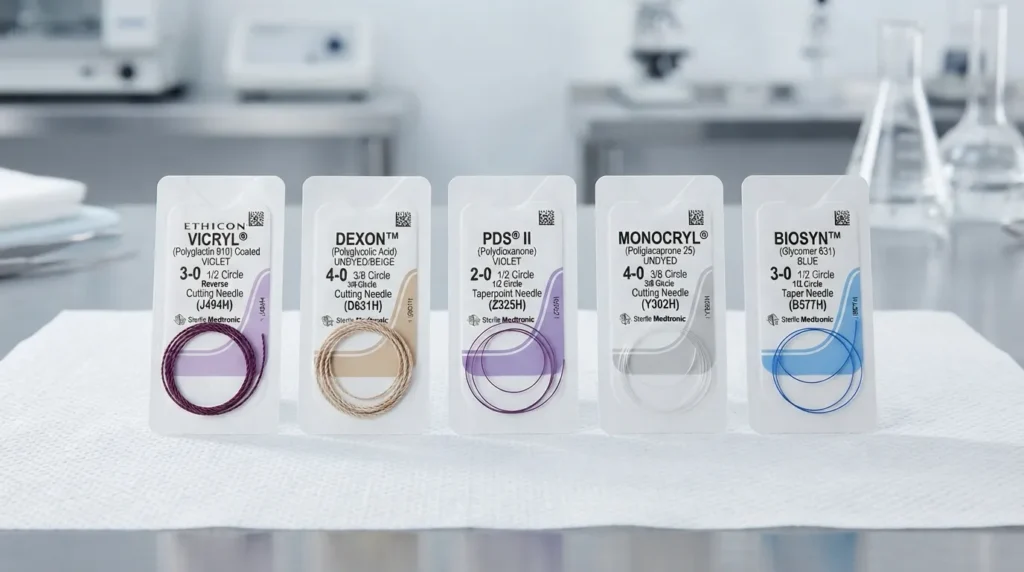
Not all dissolvable stitches break down at the same speed. The material used is one of the biggest factors in how long the dissolving process takes, and doctors choose a specific type based on the wound’s location, size, and how much support it needs during healing.
Fast-absorbing sutures
Materials like plain gut are designed to dissolve quickly, often within about a week. These are typically used for minor wounds or areas that heal fast, like facial skin or oral tissue, where long-term support isn’t necessary.
Moderate-duration sutures
Chromic gut and polyglycolic acid (PGA) fall into this category, along with polyglactin (commonly known by the brand name Vicryl). These materials retain their strength for roughly three to five weeks, making them a common choice for wounds that need more sustained support while still healing at a normal pace.
Long-lasting sutures
For deeper tissue repairs or wounds under more tension, doctors often turn to poliglecaprone (Monocryl) or polydioxanone (PDS). These materials can retain strength for several weeks and may take weeks to months to fully absorb — even though the visible wound itself often heals much sooner.
Braided vs. monofilament
Sutures also differ in structure. Braided (multifilament) threads offer more strength and flexibility but can carry a slightly higher risk of trapping bacteria. Monofilament threads are a single strand, which tends to move through tissue more smoothly and may carry a lower infection risk, though they can be less flexible to work with.
The bottom line: your doctor selects the material based on your specific wound, so the “normal” dissolve time can look very different from one procedure to the next.
Dissolve Time by Body Location/Procedure
Where your stitches are placed matters just as much as the material used. Blood flow, tissue type, and movement in the area all influence how quickly dissolvable stitches break down.
Facial and oral stitches
Areas like the face and mouth tend to heal fastest thanks to rich blood supply. Dissolvable stitches in these areas typically disappear within 5 to 14 days. Gum tissue in particular heals and dissolves quickly, often within 7 to 10 days, while stitches near the inner cheeks or tongue may take slightly longer since those areas heal at a somewhat slower pace.
Skin and surface wounds
For general skin lacerations or minor surgical incisions, dissolvable stitches usually take about 1 to 3 weeks to fully break down, depending on the suture material chosen and the size of the wound.
Internal and deep tissue sutures
Stitches used for internal repairs or deep tissue closures are built to last longer, since they need to provide structural support while deeper layers heal. These can take anywhere from several weeks to a few months to fully absorb.
Dental extraction stitches
After a tooth extraction, dissolvable stitches typically begin softening within a few days and are usually gone within one to two weeks. Because oral tissue heals quickly, these stitches are often among the faster-dissolving types.
Episiotomy and postpartum stitches
For stitches related to childbirth, healing time varies by individual, but dissolvable sutures in this area generally break down within a few weeks as the tissue heals, with many people noticing significant improvement by the three-to-four-week mark.
Across all these cases, the takeaway is the same: location affects healing speed, and healing speed affects how quickly the stitches themselves disappear.
Factors That Affect Dissolve Speed
Beyond material and location, several individual factors can speed up or slow down how quickly your dissolvable stitches break down. Understanding these can help set realistic expectations for your own recovery.
Suture material and thickness
As covered earlier, different materials are engineered to dissolve at different rates. Thicker sutures, often used for wounds under more tension, generally take longer to fully absorb than thinner ones.
Wound size, depth, and tension
Larger, deeper, or higher-tension wounds typically require stronger, longer-lasting sutures to hold tissue together during healing. As a result, these stitches are often designed to dissolve more slowly than those used for small, shallow wounds.
Blood flow to the area
Areas with strong circulation — like the face and mouth — tend to heal faster, which in turn speeds up how quickly the surrounding stitches break down. Areas with more limited blood flow may see a slower dissolving process.
Age, immune function, and nutrition
Your body’s overall healing capacity plays a role too. Younger patients and those with strong immune function often heal — and dissolve stitches — more quickly. Adequate nutrition, particularly protein and key vitamins involved in tissue repair, can also support a smoother healing timeline.
Infection or complications
If a wound becomes infected or doesn’t heal as expected, it can disrupt the normal dissolving process — sometimes causing stitches to linger longer than anticipated or requiring medical intervention. This is one of the main reasons doctors ask patients to monitor their wounds closely during recovery.
Because so many variables are at play, it’s normal for two people with similar procedures to experience slightly different dissolving timelines.
What the Dissolving Process Actually Looks and Feels Like
Knowing what’s normal during the dissolving process can make recovery feel a lot less unsettling. Here’s a general timeline of what to expect.
First few days
The stitches will look fresh and intact, holding the wound edges together. Some mild redness, swelling, or tenderness right around the site is normal during this early healing phase.
Week 1 to 2
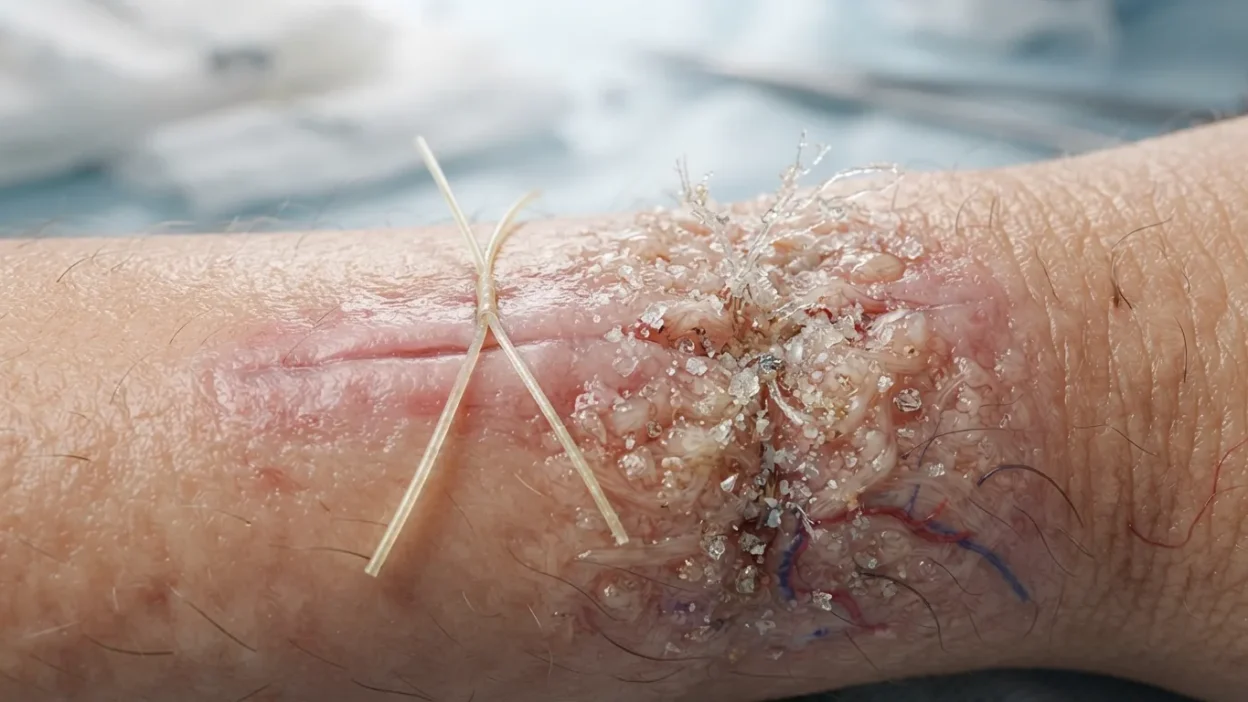
This is when many dissolvable stitches begin visibly breaking down. You may notice the material looking frayed, softer, or slightly discolored. Any visible knot on the skin’s surface often loosens and falls away during this window.
Weeks 3 to 4
The wound typically shifts from active healing into the remodeling stage. A slightly raised “mountain top” scar may form temporarily, and any earlier bruising should be fading. For deeper or internal stitches, small fragments of suture material may start pushing through the surface of the skin — a phenomenon sometimes called “spitting sutures.”
Beyond 4 weeks (for longer-lasting sutures)
Some materials continue dissolving well after the wound itself looks healed. This is normal for longer-lasting suture types and doesn’t necessarily mean anything is wrong.
Common sensations along the way
- Mild itching as the material breaks down
- A slight tugging or pulling feeling
- Small white or yellowish fragments appearing at the wound’s surface
- Occasional minor discomfort, especially as fragments work their way out
Spitting sutures can be alarming to see, but it’s a normal part of the process, not a sign of infection. That said, it’s still worth knowing the difference between normal dissolving and warning signs — which we’ll cover shortly.
Proper Care While Stitches Dissolve
How you care for your wound while the stitches dissolve can significantly affect both healing speed and the risk of complications. General guidelines apply across most procedures, but always defer to your provider’s specific instructions.
Cleaning and showering
In most cases, light showering is fine within a day or two after the procedure, but avoid soaking the area — baths, swimming pools, and hot tubs are usually off-limits until the wound has fully closed. Gently pat the area dry rather than rubbing it.
Activity restrictions
Avoid activities that stretch or put tension on the wound, especially in the first couple of weeks. Heavy lifting, strenuous exercise, or repetitive motion near the site can pull at healing tissue and may even cause stitches to fail prematurely.
Dressing and bandage care
Follow your provider’s instructions on how often to change dressings, and keep the area clean and dry between changes. If a dressing becomes wet, dirty, or starts to peel, replace it promptly to reduce infection risk.
What not to do
- Don’t pick, scratch, or pull at stitches, even if they look like they’re falling out on their own
- Don’t scrub directly over the wound
- Don’t apply lotions, ointments, or products not approved by your provider
- Don’t remove a dressing early “to check” more often than instructed
Oral care for dental stitches
For mouth-related stitches, gentle rinsing (such as a warm saltwater rinse) is often recommended, along with avoiding hard, crunchy, spicy, or sticky foods that could irritate the site.
Following these basics helps create the best possible conditions for both wound healing and normal suture dissolving — and reduces the chances of complications that could delay either process.
Warning Signs to Watch For
While most of what happens during the dissolving process is completely normal, it’s important to recognize the signs that something isn’t going as expected.
Signs of infection
- Increasing redness or warmth around the wound (rather than gradual fading)
- Swelling that worsens instead of improving
- Yellow, green, or foul-smelling discharge
- Fever or chills
- Increasing pain instead of gradual relief
Wound reopening (dehiscence)
If the edges of the wound start separating, or the stitches appear to give way before the tissue has properly healed, this needs prompt medical attention — especially for surgical incisions or deeper wounds.
Stitches lingering well past the expected timeline
Your provider will typically give you a rough estimate for how long your stitches should take to dissolve. If they’re still fully intact well beyond that window, it’s worth checking in rather than assuming it will resolve on its own.
Excessive or worsening pain
Some tenderness is expected, especially in the first few days. But pain that intensifies over time, rather than gradually easing, can be a sign of infection, improper healing, or an issue with the stitches themselves.
Unusual hardening or lumps
Occasionally, the body reacts to suture material with inflammation or the formation of a small hard lump (sometimes called a suture granuloma). While often harmless, it’s worth having a doctor take a look if it doesn’t resolve.
None of these signs are common, but knowing them means you won’t have to guess whether what you’re experiencing is a normal part of healing or something that needs medical attention.
When to Contact a Doctor
Most dissolvable stitches heal without any issues, but there are specific situations where it’s worth reaching out to your provider rather than waiting to see what happens.
Contact your doctor if you notice:
- Signs of infection, such as increasing redness, warmth, swelling, discharge, or fever
- The wound reopening or stitches appearing to fail before the area has properly healed
- Stitches still fully intact well past the timeframe your provider estimated
- Pain that worsens instead of gradually improving
- A hard lump or persistent irritation at the site that doesn’t resolve on its own
- Any general concern that something doesn’t look or feel right
What happens if a stitch doesn’t fully dissolve
Occasionally, a small fragment of suture material doesn’t fully absorb. This is usually harmless and often goes unnoticed. But if a remnant is causing ongoing irritation, redness, or discomfort after the wound has otherwise healed, a doctor or nurse can easily remove it during a quick in-office visit — no major procedure required.
When in doubt, ask
It’s always reasonable to contact your provider’s office with questions during recovery, even if you’re not sure whether something qualifies as a “real” problem. Follow-up care exists precisely because healing doesn’t always go exactly according to a general timeline, and catching an issue early typically leads to a simpler fix.
Dissolvable vs. Non-Dissolvable Stitches
Not every wound is closed with dissolvable sutures. Doctors choose between dissolvable and non-dissolvable stitches based on the type of wound, its location, and how much support it needs during healing. Here’s how the two compare:
| Dissolvable Stitches | Non-Dissolvable Stitches | |
|---|---|---|
| Material | Absorbable (e.g., gut, PGA, Vicryl, Monocryl, PDS) | Non-absorbable (e.g., silk, nylon, polyester, polypropylene) |
| Removal needed | No — breaks down naturally | Yes — removed by a provider once healed |
| Typical dissolve/removal time | 1–2 weeks (surface); weeks to months (deep/internal) | Removed in 5–14 days, depending on location |
| Common uses | Internal repairs, deep tissue, dental work, many surgical incisions | Skin closures needing extra strength, high-tension wounds, some cosmetic procedures |
| Strength retention | Gradually decreases as material absorbs | Remains constant until physically removed |
| Follow-up visit | Usually not required | Typically required for removal |
| Scarring considerations | Can vary by material; generally comparable when used appropriately | Often preferred for visible areas needing precise, controlled closure |
Why the choice matters
Non-dissolvable stitches offer more predictable, constant strength since they don’t weaken over time — which is why they’re sometimes preferred for wounds under significant tension or in highly visible areas where precise control matters. Dissolvable stitches, on the other hand, offer convenience and are especially practical for wounds that would be difficult or risky to access for removal, like internal surgical sites.
Ultimately, the decision comes down to your surgeon’s or dentist’s clinical judgment based on your specific wound and recovery needs.
Frequently Asked Questions
Do dissolvable stitches hurt as they dissolve?
Not typically. You might notice mild itching, a slight tugging sensation, or small fragments surfacing near the wound, but significant pain isn’t a normal part of the process. If pain is worsening rather than easing, it’s worth checking in with your provider.
Can dissolvable stitches get wet?
In most cases, light exposure to water — like a quick shower — is fine after the first day or two. However, soaking the area in a bath, pool, or hot tub is usually discouraged until the wound has fully closed. Always follow your provider’s specific aftercare instructions.
What happens if dissolvable stitches don’t fully dissolve?
Occasionally, a small fragment of suture material doesn’t fully absorb. This is usually harmless and may go unnoticed, but if it’s causing ongoing irritation after the wound has healed, a doctor can remove the remnant quickly during a routine visit.
Can you speed up how fast dissolvable stitches dissolve?
There’s no reliable way to intentionally speed up the process, and trying to do so — like picking at stitches — can actually increase the risk of infection or wound reopening. The best approach is proper wound care and letting the material break down naturally.
How long do internal dissolvable stitches take to dissolve?
Internal stitches are often made from longer-lasting materials designed to provide support for weeks. Full absorption can take anywhere from several weeks to a few months, even though the surrounding tissue may heal much sooner.
Is it normal to see white or yellowish material coming out of the wound?
Yes — this is often referred to as “spitting sutures,” where small fragments of the dissolving material work their way to the surface. It’s a normal part of healing, not a sign of infection, though it can look concerning at first.
Are dissolvable stitches safe for everyone, including people with allergies?
Most people tolerate dissolvable sutures well, but in rare cases, some individuals may have a sensitivity or reaction to certain suture materials. If you have a known allergy or have reacted to stitches in the past, let your provider know beforehand.
Conclusion: Key Takeaways
Dissolvable stitches are designed to make recovery easier — no follow-up appointment needed for removal, just time and proper care while your body does the rest. Here’s what to remember:
- Most dissolvable stitches disappear within 1 to 2 weeks, though certain materials used for deeper or higher-tension wounds can take several weeks to a few months to fully absorb.
- The exact timeline depends on several factors: the suture material, the wound’s location, its size and depth, and your own body’s healing pace.
- Some symptoms are completely normal during the process — mild itching, slight tugging, and small fragments surfacing at the wound (spitting sutures) are all part of typical healing.
- Proper wound care matters. Gentle cleaning, avoiding soaking or picking at the site, and following activity restrictions all support a smoother healing and dissolving process.
- Know the warning signs. Increasing redness, swelling, discharge, fever, worsening pain, or stitches remaining well past your provider’s estimated timeline are all reasons to check in with a doctor.
Every recovery looks a little different, and that’s normal. If you’re ever unsure whether what you’re experiencing is a typical part of healing or something that needs attention, don’t hesitate to reach out to your provider — a quick check-in is always better than guessing.
This article is for general informational purposes and is not a substitute for professional medical advice. Always follow your healthcare provider’s specific aftercare instructions.