Thinking about how to become a notary in Michigan? You’re in good company. Every year, thousands of Michiganders — from real estate professionals and paralegals to stay-at-home parents looking for flexible income — decide to get commissioned. And the good news is that Michigan makes the process fairly accessible: there’s no exam to pass, no mandatory training course, and most applicants can go from start to finish in just a few weeks.
That said, the process does involve a few specific steps that trip people up if they’re not prepared — securing a $10,000 surety bond, filing your oath of office with the right county clerk, and submitting your application to the correct state office, to name a few.
This guide walks you through everything you need to know, from eligibility requirements and costs to renewal timelines and how to use your commission to actually earn money once you’re licensed.
What Is a Notary Public & Why Become One?

A notary public is an official commissioned by the state to serve as an impartial witness during the signing of important documents. Their core job is to verify the identity of each signer, confirm that they’re signing willingly and knowingly, and then apply their official seal or stamp — a step that helps deter fraud and gives documents added legal credibility. Notaries are commonly called on for real estate closings, loan documents, power of attorney forms, affidavits, and other legal paperwork.
Beyond the civic role, becoming a notary in Michigan opens up some practical opportunities. Many people pursue a commission simply to support their existing job — paralegals, bankers, real estate agents, and HR professionals often find it useful to have notarial authority in-house. Others use it to build a flexible side income, offering mobile or remote notarization services on their own schedule. Either way, it’s a low-cost credential with a relatively fast path to approval.
Michigan Notary Eligibility Requirements

Before you invest time or money into the process, make sure you actually qualify. Michigan’s eligibility requirements are straightforward, but they’re strictly enforced — a mismatch on any one of these can result in an automatic denial.
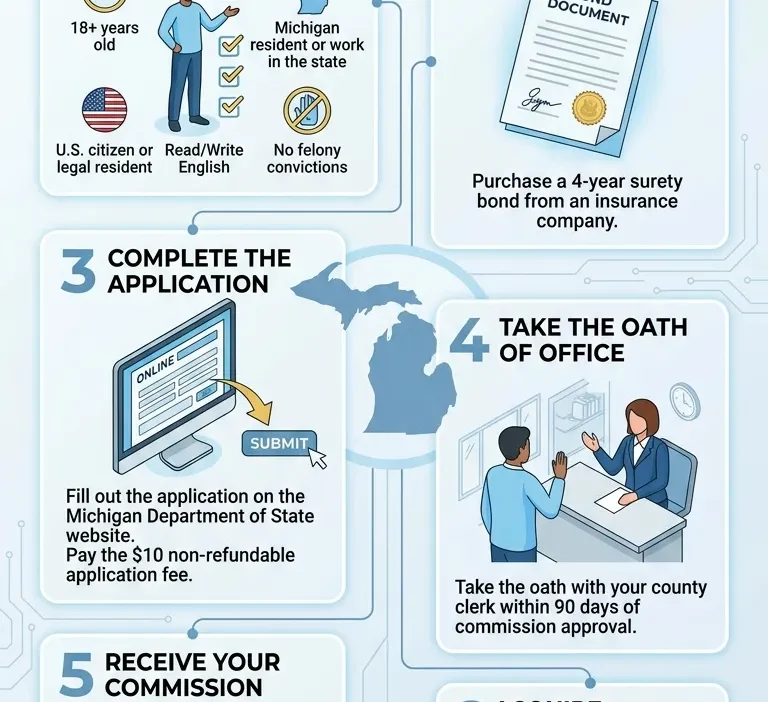
To become a notary in Michigan, you must:
- Be at least 18 years old
- Be a U.S. citizen or have proof of legal presence in the country
- Be able to read and write English
- Be a resident of Michigan, or maintain a principal place of business in the state
- Be a resident of the county where you’re requesting your appointment (non-residents must apply in the county where they work)
- Be free of any felony convictions within the past 10 years. If you were previously convicted, that 10-year window includes your full sentence, any imprisonment, parole, probation, and payment of all fines and fees
- Not have multiple qualifying misdemeanor convictions — specifically, two or more violations of the Michigan Notary Public Act within a 12-month period while commissioned, or three or more within a five-year period regardless of commission status
- Not currently be serving a prison term in any state, county, or federal correctional facility
One exception worth noting: attorneys in good standing with the State Bar of Michigan are exempt from the surety bond requirement (covered in the next section), though they still need to meet the eligibility criteria above.
Legal Framework
Michigan’s notary process is governed by two key pieces of legislation, and it’s worth understanding both before you apply.
The Michigan Notary Public Act sets the rules for who can become a notary, how commissions are issued and renewed, and what conduct can get a notary’s commission suspended or revoked. As part of your application, you’re required to sign a declaration confirming that you’ve read this Act and will perform all notarial acts faithfully.
The Michigan Law on Notarial Acts (MiLONA) governs how notarizations are actually performed — the procedures for verifying identity, acceptable forms of ID, rules around remote online notarization, and the specific language required on notarial certificates. This is the law you’ll lean on most in your day-to-day work once you’re commissioned.
Both are administered and enforced by the Michigan Department of State (Secretary of State), which issues commissions, and by county clerks, who handle bond filing and the oath of office at the local level. Familiarizing yourself with both documents isn’t just a formality — it protects you from the unlimited personal liability notaries carry for the documents they notarize.
Step-by-Step Application Process
Once you’ve confirmed your eligibility, here’s exactly how to become a notary in Michigan, from start to finish.
Step 1: Confirm Your Eligibility
Double-check the requirements outlined earlier — age, residency, citizenship, and criminal history. Any disqualifying factor will result in an automatic denial, so it’s worth ruling this out before spending any money.
Step 2: Obtain a $10,000 Surety Bond
Michigan law requires all notary applicants (except State Bar attorneys) to purchase and maintain a $10,000 surety bond for their entire commission term. This isn’t insurance for you — it protects the public from financial harm caused by notary errors. Bonds are inexpensive, typically costing $30–$60 for a full six-to-seven-year term, and are available from licensed surety bond providers or notary supply companies.
Step 3: File Your Bond and Take the Oath of Office
Bring your surety bond to your county clerk’s office — specifically, the county where you live, or where you work if you’re a non-resident applicant. The clerk will file your bond, administer your Oath of Office, and collect a county filing fee (typically $10–$20, though this varies by county).
Step 4: Complete the Official Application
Fill out the Application for Michigan Notary Public Commission, available through the Michigan Department of State’s website. Make sure you sign it exactly as your name will appear on your notarizations, and include the declaration confirming you’ve read the Michigan Notary Public Act.
Step 5: Submit Your Application and Fee
Send your completed application, proof of your filed bond, and the $10 state filing fee to the Michigan Department of State. You can typically do this online through the state’s e-Services portal or by mail to the Office of the Great Seal in Lansing. Online submission is generally faster.
Step 6: Wait for Processing
Processing usually takes a few weeks for online applications; mailed applications can take longer, especially during high-volume periods. You’ll receive your notary commission certificate once approved.
Step 7: Purchase Your Notary Seal and Supplies
With your commission in hand, you’re ready to buy your official notary stamp or seal — required to perform notarial acts — along with a notary journal, which isn’t always mandatory but is strongly recommended for keeping a legal record of your work.
Costs Breakdown
Becoming a notary in Michigan is relatively affordable compared to many professional credentials. Here’s what to budget for:
| Expense | Estimated Cost |
|---|---|
| State filing fee (Secretary of State) | $10 |
| County filing fee (varies by county) | $10–$20 |
| $10,000 surety bond | $30–$60 |
| Notary stamp/seal | $20–$40 |
| Notary journal (recommended) | $15–$30 |
| Total estimated cost | $90–$160 |
Optional Add-Ons
Beyond the required expenses, some notaries choose to invest in:
- Training courses ($30–$100) — not required in Michigan, but useful for avoiding costly mistakes, especially if you plan to specialize in loan signings
- Errors and Omissions (E&O) insurance ($50–$150/year) — this protects you from liability claims, unlike the surety bond, which protects the public
- Remote Online Notarization (RON) platform registration — costs vary by provider, and are worth considering if you plan to notarize documents remotely
For most first-time applicants, the required costs alone (bond, fees, and supplies) fall comfortably under $160 — making this one of the more budget-friendly professional credentials available in Michigan.
Timeline Expectations
One of the appealing things about becoming a notary in Michigan is how quickly you can get commissioned compared to many other credentials. Here’s a realistic breakdown of what to expect at each stage.
Getting your surety bond: Most providers issue bonds instantly or within one business day, since there’s typically no credit check involved.
County-level filing: Filing your bond and taking your oath of office at the county clerk’s office is usually a same-day process, assuming you show up with everything you need.
State application processing: This is where most of the wait happens. Applications submitted online through the Department of State’s e-Services portal tend to move faster — often within 2 to 4 weeks. Mailed applications can take up to six weeks, particularly during periods of high volume.
Receiving your supplies: Once your commission is approved, ordering your stamp and journal typically takes another few business days to a week, depending on the supplier.
Total Time Estimate
From the day you start gathering your bond to the day you’re fully equipped to notarize documents, most applicants can expect the entire process to take anywhere from 3 to 6 weeks. Choosing online submission over mail, and having your documents in order before your county clerk appointment, are the two biggest factors in staying on the faster end of that range.
Commission Term & Renewal
A Michigan notary commission doesn’t run on a flat calendar cycle — it’s tied to your birthday. Commissions last between 6 and 7 years, expiring on your birthday nearest the end of that term, which means your actual term length depends on when during the year you were originally commissioned.
Renewing Your Commission
Michigan doesn’t require continuing education or a renewal exam, which makes the renewal process nearly identical to the original application. To renew, you’ll need to:
- Obtain a new $10,000 surety bond for the upcoming term (your old bond expires with your commission)
- File the new bond and retake your Oath of Office at your county clerk’s office
- Submit a renewal application and the applicable state fee to the Michigan Department of State
Renewal Costs and Timing
Renewal fees are similar to the original application — typically around $10 for the state fee plus $10 for the county fee, on top of the cost of a new bond. It’s worth starting the renewal process a few weeks before your commission expires, since notarizing documents with a lapsed commission isn’t legally valid and could expose you to liability.
What Doesn’t Change
Your notary journal and stamp don’t need to be replaced at renewal unless your stamp reflects commission dates that have expired — many notaries simply order an updated stamp reflecting their new commission term.
Remote Online Notarization (RON) in Michigan
Michigan is one of the states that authorizes Remote Online Notarization (RON), allowing commissioned notaries to notarize documents through a live video call instead of meeting signers in person. This has become an increasingly popular option for notaries looking to expand their reach and flexibility.
How RON Works
Using audiovisual technology, a RON-certified notary can verify a signer’s identity, witness the signing of a document, and apply an electronic notarial seal — all remotely. The process typically involves identity verification methods like knowledge-based authentication or credential analysis, in addition to the live video session.
Becoming RON-Certified
To offer remote online notarization in Michigan, you must:
- Hold an active, valid Michigan notary commission
- Register as a RON notary with the Michigan Department of State
- Select and register with an approved RON technology platform that meets the state’s security and record-keeping requirements
- Maintain an electronic journal of all remote notarizations performed
Why Consider RON
Remote online notarization removes the geographic limits of traditional notary work. Instead of only serving clients who can meet you in person within your county, RON allows you to notarize documents for clients across Michigan — and in many cases, even for out-of-state parties needing a Michigan notarization. This makes it a popular add-on for notaries interested in loan signings, business services, or building a broader client base without the overhead of travel.
Notary Supplies & Tools
Once your commission is approved, you’ll need a few essential tools before you can legally perform notarial acts. Michigan has specific requirements for some of these, while others are strongly recommended best practices.
Notary Seal or Stamp (Required)
Michigan notaries must use an official seal or stamp on every notarized document. It typically must include your name exactly as it appears on your commission, the words “Notary Public,” the county of appointment or “State of Michigan,” and your commission expiration date. Most notary supply companies offer stamps designed to meet these requirements automatically — you’ll just need to confirm your commission details are accurate before ordering.
Notary Journal (Recommended)
While not universally mandated for every notarization, keeping a detailed journal of each notarial act is one of the best ways to protect yourself. A journal typically logs the date, type of document, signer’s information and ID used, and the fee charged. If a dispute or fraud claim ever arises, your journal serves as your primary evidence that you followed proper procedure.
Errors & Omissions (E&O) Insurance (Optional but Wise)
Your surety bond protects the public, not you. E&O insurance fills that gap, covering legal costs if you’re sued over an honest mistake. Given that Michigan notaries carry unlimited personal liability for their notarial acts, many professionals consider this a worthwhile investment even though it isn’t legally required.
RON Technology Platform (If Offering Remote Notarization)
If you’re pursuing Remote Online Notarization, you’ll also need to register with an approved RON platform that handles video sessions, identity verification, and electronic journaling in compliance with Michigan’s requirements.
What You Can (and Cannot) Do as a Notary
Understanding the scope of your authority — and its limits — is essential to notarizing responsibly and staying within Michigan law.
Authorized Notarial Acts
As a Michigan notary, you’re authorized to:
- Take acknowledgments, confirming a signer willingly executed a document
- Administer oaths and affirmations, such as for sworn statements or affidavits
- Witness or attest signatures on legal documents
- Certify copies of certain documents
- Perform jurats, where a signer swears to the truthfulness of a document’s contents in your presence
Fee Limits
Michigan law caps what notaries can charge for a standard notarial act at $10 per act. This fee limit applies to the notarization itself — but notaries can (and often do) charge separately for related services like travel (mobile notary work) or loan signing appointments, which aren’t subject to the same cap.
What You Cannot Do
There are important restrictions to keep in mind:
- You cannot notarize documents in which you have a personal financial or beneficial interest — for example, notarizing your own signature or a document where you’re a named party
- You cannot provide legal advice unless you’re also a licensed attorney — notaries are not authorized to draft legal documents, explain legal rights, or recommend how someone should complete a form
- You cannot notarize for a family member’s transaction in most cases where you’d personally benefit
- You cannot notarize a document if the signer isn’t present (except under Michigan’s approved RON procedures) or if you cannot properly verify their identity
Violating these boundaries — even unintentionally — can expose you to the unlimited personal liability notaries carry, and in serious cases, can result in suspension or revocation of your commission.
Ways to Use Your Commission (Income Opportunities)
For many people, getting commissioned is just the starting point — the real value comes from putting that credential to work. Here are the most common ways Michigan notaries turn their commission into income.
Loan Signing Agent
Loan signing agents specialize in notarizing real estate closing documents — mortgages, refinances, and title transfers. This is one of the more lucrative paths, with signings often paying $75–$200 per appointment. Many notaries pursue additional loan signing certification (not required by the state, but often expected by title companies and signing services) to break into this niche.
Mobile Notary
Mobile notaries travel to clients — homes, offices, hospitals, or wherever a signing needs to happen — rather than requiring clients to come to them. This convenience commands a premium: mobile notaries typically charge a travel fee on top of the standard $10 per-act notarization fee, which can range from $25–$75 or more depending on distance and urgency.
Remote Online Notary (RON)
As covered earlier, RON-certified notaries can serve clients anywhere without geographic restrictions, making it possible to build a much larger client base than in-person work alone allows. This is especially appealing for notaries looking to work from home or supplement a full-time job with flexible hours.
In-House or Workplace Notary
Many notaries never advertise their services publicly at all — they simply use their commission to support their existing job. Real estate agents, paralegals, bank employees, and HR professionals frequently find that having notarial authority in-house saves their employer time and money, and can make the notary more valuable in their role.
Combining Multiple Paths
Many experienced notaries don’t limit themselves to just one avenue — combining loan signing work, mobile services, and RON certification allows them to maximize both flexibility and income potential from a single commission.
Common Mistakes to Avoid
Even though Michigan’s notary process is relatively simple, a handful of avoidable errors trip up applicants and commissioned notaries alike.
Letting Your Bond or Commission Lapse
Notarizing documents with an expired commission or bond isn’t just a paperwork issue — it can invalidate the notarization entirely and expose you to personal liability. Mark your renewal date well in advance and start the process a few weeks early.
Applying in the Wrong County
Your application must be filed in the county where you live (or where you work, if you’re a non-resident applicant). Filing in the wrong county can delay or derail your application entirely.
Skipping the Journal
While a journal isn’t mandatory for every notarization, notaries who skip it leave themselves with no record to fall back on if a signer later disputes a transaction. A consistent journal habit is one of the simplest ways to protect yourself.
Overcharging for Notarial Acts
Michigan caps the fee for a standard notarial act at $10. Charging more than that for the notarization itself — as opposed to separate, clearly itemized travel or service fees — is a violation of state law and can jeopardize your commission.
Notarizing for Yourself or Immediate Financial Interest
Notarizing your own signature, or a document where you have a personal financial stake, is one of the most common conflicts of interest that can lead to a commission being challenged or revoked.
Mismatched Signatures
Your notary stamp and your signature on applications and notarizations must exactly match the name on your commission. Even small discrepancies (a missing middle initial, a nickname instead of a legal name) can cause processing delays or call a notarization’s validity into question.
Assuming RON Is Automatic
Being a commissioned notary doesn’t automatically authorize you to perform remote online notarizations. Skipping the separate RON registration step is a common oversight for notaries eager to start working remotely.
Frequently Asked Questions
Is an exam required to become a notary in Michigan?
No. Michigan is one of the states that doesn’t require applicants to pass a notary exam before receiving their commission.
Is training required?
No, formal training isn’t mandatory. That said, a notary education course is often recommended, especially for those planning to specialize in loan signings or remote online notarization, since it can help you avoid costly procedural mistakes.
How much can a Michigan notary charge?
State law caps the fee for a standard notarial act at $10. Additional services like travel (for mobile notaries) or loan signing appointments can be charged separately and aren’t subject to that cap.
Can non-residents become a Michigan notary?
Yes. Non-residents can apply if their job requires them to perform notarial acts in Michigan and they maintain a principal place of business in the county where they’re requesting appointment. Non-resident applicants must also submit additional documentation, including a copy of their out-of-state driver’s license and a signed employer letter.
What happens if my name or address changes after I’m commissioned?
You’re required to notify the Michigan Department of State of any changes to your legal name or address during your commission term, since your stamp and records must always reflect accurate information.
Can someone with a felony conviction become a notary in Michigan?
It depends on timing. Applicants are disqualified if they have a felony conviction within the past 10 years. If the conviction happened outside that window — and the sentence, parole, probation, and all fines have been fully completed — they may still be eligible.
How long does the entire process take?
Most applicants can expect the full process — from obtaining a bond to receiving a commission — to take about 3 to 6 weeks, with online applications processing faster than mailed ones.
Do I need E&O insurance?
It’s not legally required, but since Michigan notaries carry unlimited personal liability for their notarial acts, many professionals choose to carry it for extra protection.
Conclusion & Next Steps
Learning how to become a notary in Michigan really comes down to a handful of manageable steps: confirming your eligibility, securing your $10,000 surety bond, filing your oath of office with your county clerk, and submitting your application to the Michigan Department of State. With no exam required and total costs typically landing under $160, it’s one of the more accessible professional credentials available — and one that can pay for itself quickly, whether you use it to support your existing career or build a flexible side income through mobile, loan signing, or remote online notary work.
Your Next Steps
- Review the eligibility requirements one more time to confirm you qualify
- Purchase your $10,000 surety bond from a licensed provider
- Visit your county clerk’s office to file your bond and take your oath of office
- Submit your application and fee to the Michigan Department of State
- Once approved, order your notary seal and journal — and consider whether RON certification fits your goals
This article is for general informational purposes only and isn’t legal advice. Requirements, fees, and forms can change, so always verify current details with the Michigan Department of State before applying.