Few things trigger instant anxiety like the thought that you might have a warrant out for your arrest. Maybe you missed a court date, forgot about an old traffic ticket, or heard from a friend that “the police were asking about you.” Whatever the reason, not knowing is often worse than knowing — and the good news is that finding out doesn’t require a lawyer, a private investigator, or a trip to the police station.
In this guide, you’ll learn exactly what a warrant is, the most common reasons they’re issued, and several free and reliable ways to check whether you have one — from county sheriff databases to court clerk lookups. We’ll also cover which methods carry risk, what information you’ll need before you start searching, and what steps to take if you do discover an active warrant.
What Is a Warrant? (The Basics)
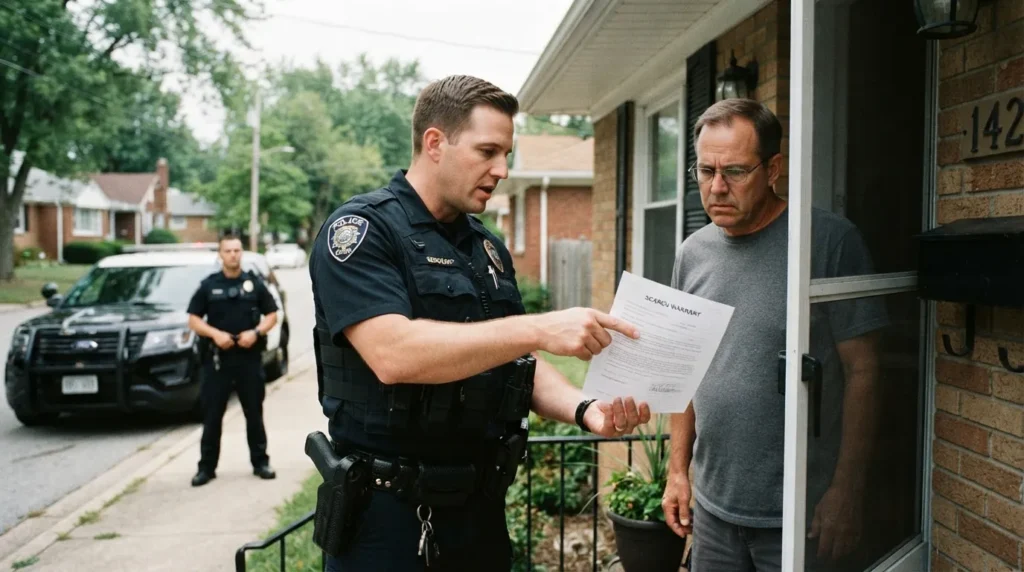
A warrant is a legal document signed by a judge that authorizes law enforcement to take a specific action — whether that’s arresting a person, searching a property, or both. Warrants aren’t issued casually; they require a judge to find “probable cause,” meaning there’s a reasonable basis to believe a law was broken or evidence exists somewhere specific.
Not all warrants work the same way, though, and understanding the differences matters:
Arrest warrant — Authorizes police to arrest a named individual. It’s typically issued when someone is formally charged with a crime, or when there’s enough evidence to believe they committed one.
Search warrant — Authorizes police to search a specific location (a home, vehicle, or business) for evidence related to a crime. This type doesn’t necessarily mean you’re the target of an arrest, but it can be part of a larger investigation.
Bench warrant — Issued directly by a judge, usually because someone failed to appear in court, skipped a required hearing, or violated a court order. These are extremely common and often catch people off guard, since they can result from something as minor as forgetting a court date for a traffic ticket.
It’s also worth understanding the difference between:
- Felony warrants — Tied to more serious charges, these are prioritized by law enforcement and carry a higher risk of arrest at any interaction with police (traffic stops, ID checks, etc.).
- Misdemeanor warrants — Tied to lesser offenses. Police may still arrest on these, but enforcement can vary depending on local policy and department resources.
Knowing which type of warrant might apply to your situation helps you understand both the urgency of resolving it and which government agency is likely to have the record.
Common Reasons Warrants Get Issued
Warrants aren’t only issued for serious crimes — many are the result of missed paperwork, deadlines, or administrative slip-ups. Understanding the common triggers can help you figure out whether you might actually have one.
Failure to appear in court
This is by far the most common reason for a bench warrant. If you were scheduled for a court date — even for something minor like a traffic citation — and didn’t show up, a judge can issue a warrant automatically, often without any additional notice.
Unpaid traffic tickets or fines
Ignoring a ticket doesn’t make it go away. In many states, unpaid fines escalate into a missed court date, which then triggers a bench warrant.
Probation or parole violations
Missing a check-in, failing a drug test, or breaking any condition of probation or parole can prompt a judge to issue a warrant for violation of the terms.
Child support non-payment
In many jurisdictions, falling significantly behind on court-ordered child support can result in a civil bench warrant, separate from any criminal warrant.
Being named in an active criminal investigation
Sometimes a warrant is issued because law enforcement has gathered enough evidence to formally charge someone — even before that person is aware they’re under investigation.
Contempt of court
Disobeying a judge’s order, whether in a criminal or civil case, can result in a warrant for contempt.
Recognizing which of these situations might apply to you is often the first clue that a warrant search is worth doing.
Signs You Might Have a Warrant (Without Checking Yet)
Before you even run a search, there are often small clues that suggest a warrant may already exist. If any of the following sound familiar, it’s worth prioritizing a check.
You missed a court date
Even if it slipped your mind entirely, missing any scheduled court appearance — including for a minor citation — is one of the most reliable predictors of a bench warrant.
You never responded to a ticket or citation
If you set aside a ticket and forgot to pay it or contest it by the deadline, that’s a common path to an unpaid-fine warrant.
You received mail from a court or collections agency
Letters referencing a case number, a “failure to appear” notice, or a collections agency chasing a court fine are strong signals something is still open.
A process server or officer tried to reach you
If someone claiming to be a process server came to your home or workplace, or if a family member mentioned police stopped by asking for you, that’s worth taking seriously.
A friend or relative was asked about you by police
Sometimes people find out about a warrant secondhand — through a relative, employer, or friend who was contacted directly.
None of these guarantee a warrant exists, but they’re strong enough indicators that a quick search is a smart next step rather than something to put off.
How to Check for a Warrant: Step-by-Step Methods
There are several reliable ways to check for a warrant, ranging from free government resources to paid background check tools. Start with the free, official options — they’re generally the most accurate.
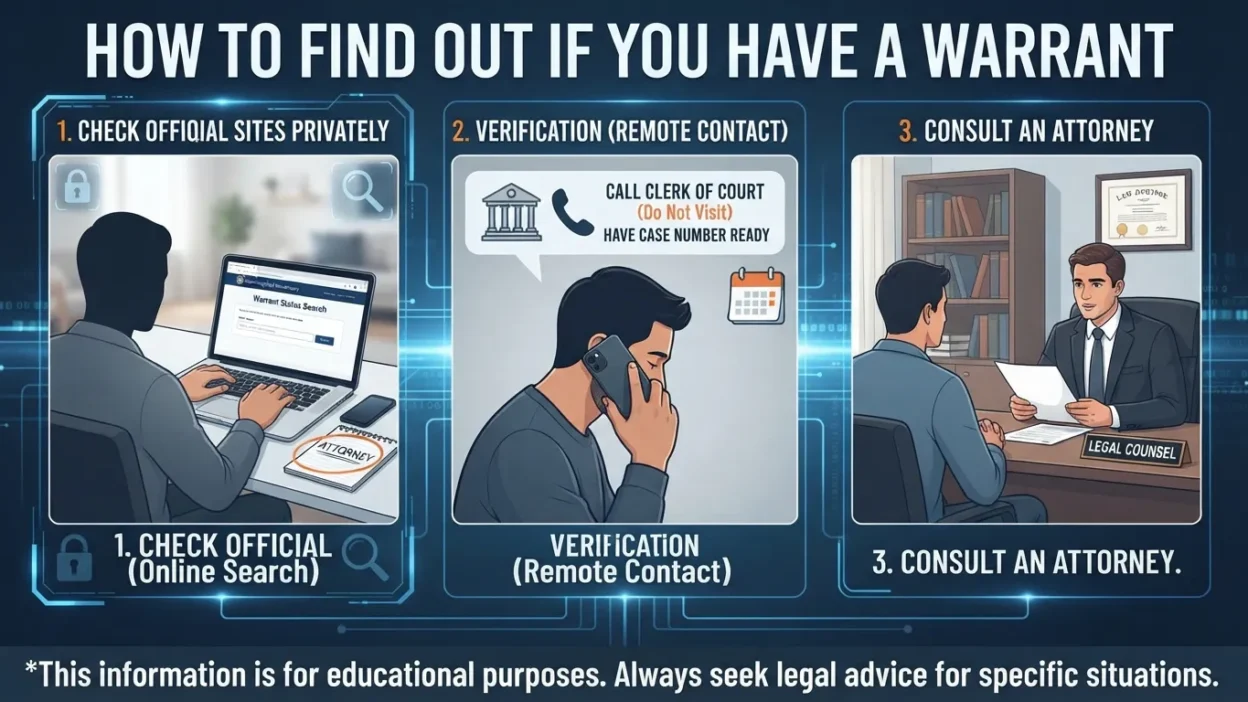
5.1 County Sheriff’s Office
Most county sheriff’s offices maintain a searchable list of active warrants on their official website. Search “[your county] sheriff active warrants” to find it. These lists are usually updated regularly and are free to use, though coverage and detail vary by county.
5.2 County or State Court Clerk’s Case Search
Court clerks maintain case records, which is often the most direct way to confirm a warrant tied to a missed court date or unpaid fine. Look for a “case search” or “online docket” tool on your county or state court website, then search using your full name and date of birth.
5.3 State Police / State Judiciary Portals
Some states run centralized warrant databases through the state police or judicial branch, separate from individual counties. These vary widely — a few states offer robust statewide search tools, while others leave it entirely to the county level.
5.4 Calling the Courthouse Clerk Directly
If you can’t find the information online, calling the clerk’s office is a legitimate and low-risk option. You can simply ask, “Can you tell me if there’s an active warrant under my name?” Clerks handle this request regularly and typically won’t take action against you just for asking.
5.5 Hiring a Criminal Defense Attorney to Check
This is often the safest method, especially if you suspect a more serious warrant. An attorney can check court records on your behalf, and because of attorney-client privilege, the inquiry itself stays confidential — giving you time to plan your next steps before anyone else is alerted.
5.6 National and Third-Party Background Check Sites
Paid background check services often advertise “instant” warrant searches. These can be a useful starting point, but they pull from a patchwork of public records that may be outdated, incomplete, or simply wrong. Never treat a third-party site as the final word — always confirm through an official court or sheriff’s source before acting on the result.
Methods That Carry Risk (Use With Caution)
Not every way of checking for a warrant is equally safe. A few approaches can accidentally turn a simple inquiry into an unplanned arrest, so it’s worth knowing which methods to be careful with.
Calling the police non-emergency line and asking directly
This might seem like the most straightforward option, but it carries real risk. If a warrant exists, some departments may use the call to locate you or send an officer to your location. At minimum, you lose the ability to plan your next steps on your own terms.
Walking into a police station to ask in person
Similar risk applies here — if an active warrant comes up during the inquiry, you could be taken into custody on the spot, with no opportunity to arrange bail, contact an attorney, or prepare your family.
Why a buffer matters in higher-stakes situations
If you have reason to believe the warrant might be serious (a felony charge, for example), it’s worth using a method that doesn’t put you face-to-face with law enforcement until you’ve had a chance to consult an attorney. This is exactly why hiring a criminal defense attorney to check on your behalf (covered in Section 5.5) is often recommended over calling or visiting police directly — it gives you the information without the exposure.
The safest approach is almost always to start with free public records (sheriff or court websites) or an attorney, and treat direct contact with police as a last resort rather than a first step.
What Information You’ll Need to Search Effectively
Before you start searching, gathering a few key details in advance will make the process faster and more accurate — most databases won’t return reliable results without them.
Full legal name and any aliases
Use your complete legal name exactly as it appears on official documents. If you’ve ever gone by a maiden name, nickname, or previous legal name, have those on hand too, since older records may be filed under a different name.
Date of birth
Almost every court and sheriff database requires a date of birth to narrow results and confirm you’re looking at the right person, especially if your name is common.
State and county where the offense may have occurred
Warrant records are typically maintained at the county or state level, not nationally, so knowing where the situation originated (where you got the ticket, where the court case was filed, etc.) will save you from searching the wrong jurisdiction.
Case or citation number, if you have one
If you kept any paperwork — a traffic ticket, a court notice, a citation — the case number can let you skip straight to the specific record instead of searching by name alone.
Having this information ready before you start also reduces the chances of a false negative, where a search comes back empty simply because a name was misspelled or a birth date didn’t match.
Special Situations
Not every warrant search is straightforward. A few scenarios are worth understanding on their own, since they change how — and where — you should look.
Out-of-state warrants
A warrant issued in one state doesn’t disappear just because you’ve moved. Whether it follows you depends largely on the severity of the charge and whether the issuing state pursues extradition. Minor misdemeanor warrants are often not worth the cost of extradition for another state, while felony warrants are far more likely to be actively pursued across state lines. If you’ve lived in multiple states, it’s worth checking records in each one.
Do warrants expire?
In most cases, no — warrants don’t expire simply with the passage of time. They generally remain active until they’re resolved, whether through arrest, voluntary surrender, or a court dismissing the case. That said, some jurisdictions have statutes of limitations on prosecuting certain offenses, which can affect whether a case (and its associated warrant) is still enforceable. This varies significantly by state and charge type, so it’s not something to assume without checking.
Checking on behalf of someone else
If you’re trying to find out whether a family member has a warrant, most of the same public search methods apply — sheriff’s office lists and court case search tools are typically public record and don’t require the person’s permission to search. Just keep in mind that some jurisdictions limit online results for privacy reasons, in which case a phone call to the clerk’s office may be necessary.
Immigration-related concerns
For non-citizens, a warrant — even a minor one — can carry consequences beyond the criminal justice system, including potential immigration enforcement involvement. This is a nuanced area where the stakes are especially high, so anyone in this situation should consult an immigration attorney before taking any action, rather than relying on general guidance.
What to Do If You Discover You Have a Warrant
Finding an active warrant is unsettling, but panicking or ignoring it are the two worst responses. There’s almost always a path forward that minimizes disruption to your life — as long as you handle it deliberately.
Don’t panic, and don’t ignore it
Warrants don’t go away on their own, and unresolved warrants tend to escalate over time — sometimes resulting in higher bail amounts or added charges for failure to appear. The sooner you address it, the more control you have over the outcome.
Contact a criminal defense attorney first
Before contacting a court, a bail bondsman, or law enforcement, talk to an attorney. They can confirm the exact charge, explain what to expect, and often negotiate the terms of how and when you turn yourself in — sometimes avoiding an unplanned arrest entirely.
Your main options once you know
- Voluntary surrender — Turning yourself in on your own terms, often arranged in advance with your attorney, typically results in a smoother process than being arrested unexpectedly.
- Attorney-negotiated resolution — In some cases, an attorney can resolve a minor warrant (like an old unpaid ticket) without requiring an in-person surrender at all.
- Posting bond — If the warrant carries a set bail amount, you or your attorney may be able to arrange this in advance, reducing time spent in custody.
What to expect during a voluntary surrender
Typically, you’ll go to the courthouse or jail at an agreed-upon time, be booked (fingerprints, photo, paperwork), and either post bail or wait for a bail hearing. Having an attorney present or on call can shorten this process significantly.
The cost of continuing to ignore it
Warrants don’t get “smaller” with time. In fact, ignoring one often leads to added charges, higher bail, or being taken into custody unexpectedly — during a routine traffic stop, at a job background check, or even during an unrelated encounter with police.
How to Prevent Future Warrants
Most warrants are avoidable with a little organization. A few simple habits can keep a minor issue — like a forgotten ticket — from ever escalating into a legal problem.
Keep your contact information updated with the court
If you move, change your phone number, or get a new email, update it with any court you have an open case or citation with. Missed notices are one of the most common reasons people miss court dates without realizing it.
Track court dates and ticket deadlines
Write down every court date and payment deadline the moment you receive it — in a calendar, phone reminder, or planner. A single missed date is often all it takes to trigger a bench warrant.
Pay fines and tickets promptly, or contest them properly
If you disagree with a ticket, don’t just ignore it — file a formal contest through the court. Simply not paying and not responding is what typically leads to escalation.
Respond immediately to any court-related mail
Letters from a court, even ones that look routine, often have real deadlines attached. Open and read them as soon as they arrive rather than setting them aside.
Staying organized around court dates and payments is a small effort that prevents the much bigger hassle — and risk — of dealing with an active warrant later.
Frequently Asked Questions
Can I check for a warrant for free?
Yes. County sheriff websites and court clerk case search tools are the most reliable free options. Paid background check sites exist too, but they’re not always more accurate.
Will checking online alert the police?
No. Public sheriff and court record searches are informational lookups, not requests that notify law enforcement. This is different from calling police directly and asking, which can prompt action.
Do warrants show up on background checks?
Often, yes — especially for employment or housing background checks that pull from criminal or court records. This is one more reason to resolve a warrant proactively rather than letting it surface unexpectedly.
Can a warrant affect my employment?
It can, particularly if a background check reveals an active warrant or if an arrest occurs during work hours. Resolving a warrant before it’s discovered this way is almost always the better outcome.
How long do warrants stay active?
In most cases, indefinitely — they don’t expire simply due to time passing. They remain open until resolved through arrest, surrender, or the court dismissing the underlying case (subject to any applicable statute of limitations).
Can police lie about whether I have a warrant?
Law enforcement in the U.S. is generally permitted to use deception during investigations, including about the existence of a warrant. This is one more reason official records (court or sheriff’s office) are more reliable than taking anyone’s word for it, including law enforcement’s.
Conclusion
Not knowing whether you have a warrant is often more stressful than actually finding out. The good news is that checking is usually free, private, and doesn’t require setting foot in a police station — a quick search through your county sheriff’s office or court clerk’s website is often all it takes to get a clear answer.
If that search does turn up an active warrant, don’t panic and don’t ignore it. Reach out to a criminal defense attorney before contacting law enforcement directly — they can walk you through your options, from voluntary surrender to negotiating a resolution, and help you avoid an unplanned arrest. And going forward, a little organization around court dates and payment deadlines goes a long way toward making sure you never have to ask this question again.
This article is for general informational purposes only and is not a substitute for legal advice. If you have questions about a specific legal situation, consult a licensed attorney in your state.